


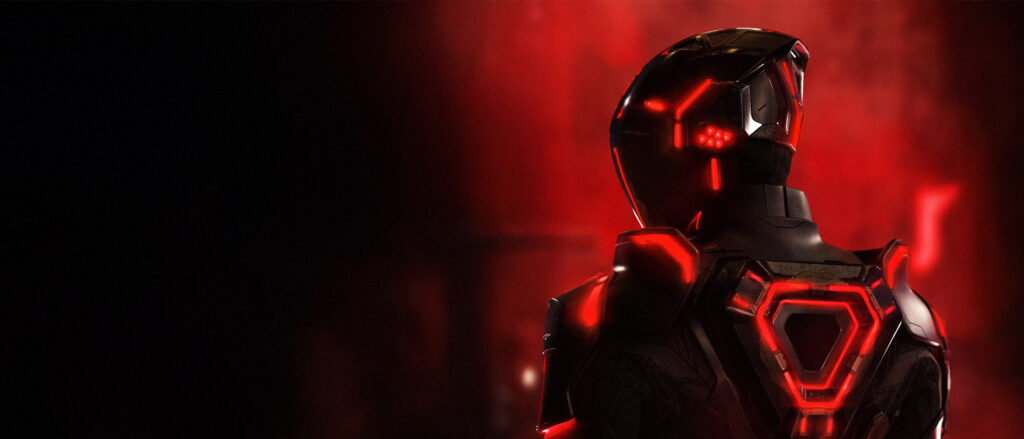


With Tron: Ares The third part of the cyberspace sci-fi saga that started in the 1980s has come to cinemas. In it, the AI programs from the grid enter the real world for the first time and cause chaos that is spectacular to watch. Unfortunately, the film doesn’t have much more to offer than beautiful pictures and good music.
By Michael Förtsch
Just recently, the developer of ChatGPT, OpenAI, presented the next step in artificial intelligence. However, it wasn’t about the possibility of curing diseases like cancer, ending world hunger or dampening the energy hunger of artificial intelligence, but rather the ability to generate absurd videos in which, for example, Sam Altman jumps through the OpenAI office in a cat costume and shouts “Meow! Meow!” calls.
In Tron: Aresthe third part of the Disney film series that began in 1982, AI is also not used to solve humanity’s major problems. But not for harmless cat videos either. We remember: In Tron It’s all about the Grid, the digital world created by the brilliant computer scientist Kevin Flynn in which programs exist in humanoid form. In Tron: Ares The incredibly advanced AI is intended to serve one purpose above all: war – and not in the digital world, but in the real world. The technology is not intended to be researched in detail, but rather used as profitably as possible.
The one shot by director Joachim Rønning Tron: Ares sets 15 years later Tron: Legacy and 36 years after the original. However, their exact plot is only partially relevant here – the titular program Tron and other characters from the original do not appear at all, with one exception. At the beginning, a sequence of news reports explains what the viewer really needs to know. The company ENCOM, once led by Flynn, and its rival Dillinger Systems, whose founder Ed Dillinger once stole Flynn’s technology, are still in competition today. The founder’s grandson took over the management of Dillinger Systems – the arrogant and self-confident Julian. And he puts everything on one card to finally outdo ENCOM.
“So much talk about AI and Big Tech today,” says Julian as he stands in front of a group of generals from all over the world and presents them with his breakthrough. With the help of Flynn’s AI technology, Dillinger Systems created its own grid and programmed – or rather trained – Ares, played by Jared Leto, as the perfect soldier. He can run other programs, break into other people’s computer systems, and much more. Used on a real battlefield Ares but rather little. However, Dillinger is now presenting a type of laser printer that can be used to make Ares, but also vehicles and airplanes Tron-world can be brought into the real world: materialless information is thereby manifested. How exactly does this work? This will not be discussed further. The problem: The materialization only lasts 29 minutes.
But a discovery by ENCOM boss Eve Kim, played by Greta Lee, in Flynn’s abandoned hermitage in the middle of the snowy wasteland somewhere near Skagway, Alaska, could change that. Because Flynn apparently had one decades ago Permanence Code discovered that gives digital entities a type of DNA that can bind them to the real world. Kim can use it to bring an orange tree from the digital world into reality that exists for hours upon hours. Dillinger wants this code – and puts Ares and his warriors to it. Because of course he didn’t tell potential customers that his digital creations fall apart after less than half an hour.
Chic…but not much more
What follows in the almost two hours are extremely stylish scenes in which Ares and Eve chase each other through a big city with the legendary Light Cycles. The light barriers they drag behind them cut up a police car and caused other cars to roll over. Virtual aircraft will soon fly over high-rise buildings and duel with jets. The contrast between digital and material aesthetics has never been seen before – it can certainly inspire. And the sequences in which the digital structures are conjured out of nowhere by 3D printers with whirring laser beams also look impressive. There is also a nostalgic detour into the 80s version of grid cyberspace.
But otherwise offers Tron: Ares unfortunately not much. Only Ares’ transformation from an unfeeling program to a digital and fairly human consciousness is interesting as a concept, but implemented in a banal way and all too quickly. And… Jared Leto isn’t really credible as a militarily pragmatic warrior right from the start. Something that cannot be attributed exclusively to the actor himself. Because in Blade Runner 2049 Leto played the company leader Niander Wallace as a calculating, cold-hearted and downright inhuman would-be god in a shockingly believable way. Either way: Tron: Ares remains flat and disappointingly uninteresting when it comes to the topic of artificial intelligence.
There would have been many exciting starting points. The constellation of characters would have provided space and time to explore the relationship between humans and artificial intelligence in more detail. The film could have questioned whether the feelings a digital being experiences are real or just a simulation. Whether an artificial intelligence can be made to understand the meaning of human life, morals and ethics. How we humans can ensure that we can trust digital beings who make their decisions automatically and according to mechanisms and rules that we cannot understand. Or how and why an artificial intelligence can develop an instinct for self-preservation – a phenomenon that is currently apparently becoming visible again and again in current language models and leaves AI researchers puzzled. And anyway: whether it is negligent to simply release such technology into the world.
At least a good soundtrack
The world and the plot elements themselves also offered a lot of potential to expand the Tron universe, make it more exciting and worth exploring. A lot in Tron: Ares is simply accepted and not questioned. What are the AI warriors and machines actually formed from when they are assembled by lasers? What mysterious energy powers the digital machines as they whiz and fly around in the real world? Is it possible that the digital world and reality are not so different after all? Does this perhaps even support the simulation hypothesis? Is the grid just a computer program within a computer program? Sure, that might be a bit overkill, but there could have been a little more mystery Tron: Ares definitely done well.
Unfortunately, it doesn’t work Tron: Ares So neither as a comment on the current AI hype nor on digitalization in general. The characters, action and plot are too flat for that. Despite all this, you can Tron: Ares entertained by the skillfully stylish and at times stunning camera work of Jeff Cronenweth and the fantastic effects of Industrial Light & Magic. Additionally, even though Depeche Mode seems to be Ares’ favorite band, the soundtrack is by Nine Inch Nails. Here, sometimes driving, electronic pieces are mixed with sometimes industrial, rocky and sometimes ethereal synth sounds that sometimes seem creeping, eerie, then again driving and rushing forward.


André Itamara Vila Neto é um blogueiro apaixonado por guias de viagem e criador do Road Trips for the Rockstars . Apaixonado por explorar tesouros escondidos e rotas cênicas ao redor do mundo, André compartilha guias de viagem detalhados, dicas e experiências reais para inspirar outros aventureiros a pegar a estrada com confiança. Seja planejando a viagem perfeita ou descobrindo tesouros locais, a missão de André é tornar cada jornada inesquecível.
📧 E-mail: andreitamaravilaneto@gmail.com 🌍 Site: roadtripsfortherockstars.com 📱 Contato WhatsApp: +55 44 99822-5750