
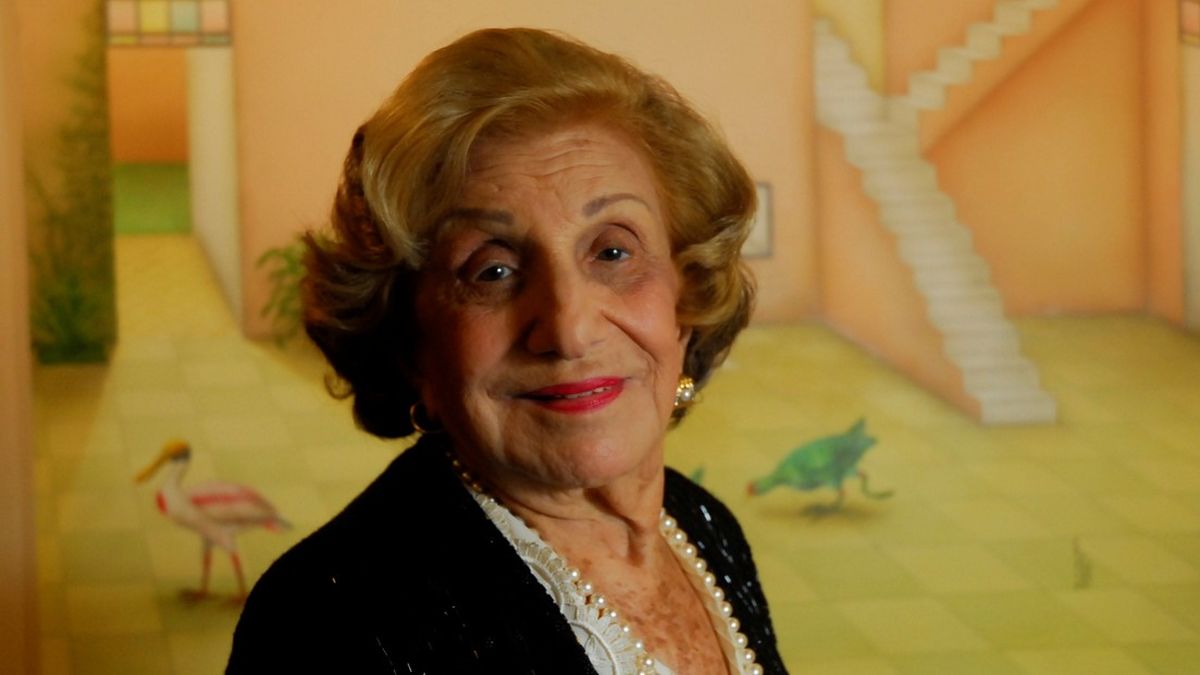
If we add that the setting for all this was Recoleta, that behind the event there was an important inheritance and that Kohen was a well-known plastic artist, writer and patron from Buenos Aires, we realize how this event resonated among the people. And we also add a color component: Natalia Kohen was born in Mendoza.
In that same 2022, Zito published “27 nights” (Ed. Galerna), a non-fiction book in which he narrated his extensive investigation into the unjust internment of Sarah Katz, the name with which he masked the true identity of the protagonist.
Now, that book went much further than the journalist and surely Kohen herself once thought. Of course: China Zorrilla had already guessed it. The Uruguayan actor and director Daniel Hendler adapted it into a film of the same name that, as of this Friday, October 17, is in the catalog of Netflix. His version of the story had certain fictionalizations: new characters, new name changes (here the protagonist is neither Natalia Kohen nor Sarah Katz, but Martha Hoffmann) and some humorous episodes that surely did not exist in real life.
An investigation, a book, a movie
“One afternoon in June 2005, Sarah Katz, an eighty-eight-year-old writer, artist and patron, is surprised in her apartment in Recoleta by six nurses who, with the consent of her daughters, admit her to a psychiatric hospital. The reason? Sarah’s strange behavior, which, according to her daughters, includes the squandering of the family fortune, a sexually active life and a lifestyle inappropriate for his age.” This is how the back cover of “27 nights” begins.
The pages review the life of the artist (who married the prestigious doctor Mauricio Kohen) and, above all, the twenty-seven days – hence the title – that she remained hospitalized and her “release”, after the public intervention of her colleagues and the dissemination of the case in the press.
It is shocking to think that Kohen survived those terrible days of isolation for 17 years. Zito remembered the day he met her like this, years after her hospitalization: “Natalia, at 99 years old, was not an old woman, she was still a woman with an attractiveness that was difficult to explain, she was not a kind grandmother, she retained – on the contrary – the sharp traits of her heyday, the ability to say at her convenience or return a question instead of answering, all with enviable skill. I found in Natalia a version of old age that I didn’t know, a version that I wanted to keep, that I remember every time I think about getting old.“.
That interview with Kohen was just one point in an investigation that lasted a year and a half, and in which no less than 50 people were taken as sources. “Among them I tried to interview Facundo Manes,” he said in an interview with Página/12. “At one point he gave a talk and I went to listen to him and then I approached him to tell him that I was writing this book and I asked him for an interview and then the interview was not possible“Zito lamented.
And he added: “I would have loved to talk to him. I couldn’t talk to the daughters either. Yes, I was able to speak on the phone with one of his granddaughters and other relatives.“.
That is why, when watching the Netflix movie, it is advisable not to take everything as real. In fact, Hendler’s own character (who in addition to directing also acts) is a deliberate fictionalization. He plays Casares, a judicial expert who must evaluate Hoffmann’s mental state – now played by the always brilliant Marilu Marini—, to determine if she can continue her life autonomously or if, as her daughters propose, it is appropriate to admit her to a psychiatric institution.
The adaptation was also signed by a renowned storyteller such as Mariano Llinás (“Extraordinary Stories”, “La flor” and screenwriter of “Argentina, 1985”), as well as Agustina Liendo and Martín Mauregui.
Who was Natalia Kohen, artist from Mendoza
She was born Natalia Cohan in 1918 (or 1919, according to other sources), in Mendoza. His life was, from early on, a bridge between letters and the visual arts, between introspection and creation.
After completing high school, he moved to Buenos Aires, where he studied at the Faculty of Philosophy and Letters of the UBA. Her early humanist training led her to work as a literature teacher and, shortly after, to write. He published books of stories and poems that earned him recognition and awards, and that already revealed an intimate, sharp and reflective voice. During those years he also undertook study trips to America, Europe and the East, an experience that would profoundly mark his outlook and his artistic sensitivity.
In Buenos Aires he met Mauricio Kohen, then a young medical sales representative who would eventually become an influential pharmaceutical industrialist, owner of the Argentia company. This bond would be, in addition to being emotional, an intellectual and cultural alliance. Together they promoted projects linked to art and education, and Natalia served for several years as director of the Argentia Foundation, an institution that sought to articulate science and culture as drivers of human development.
Plastic art came into his life like a second youth. Already with experience in writing and cultural management, he decided to study painting with the engraver Aída Carballo, one of the most relevant figures of Argentine art of the 20th century. Later he studied at the Sir John Cass School of Art and at the Drawing and Engraving Office of the British Museum in London. From then on, his work began to gain space in galleries and museums both in Argentina and abroad. His painting, drawing and engraving exhibitions were celebrated by critics, and he obtained numerous municipal and national awards.
Natalia Cohen
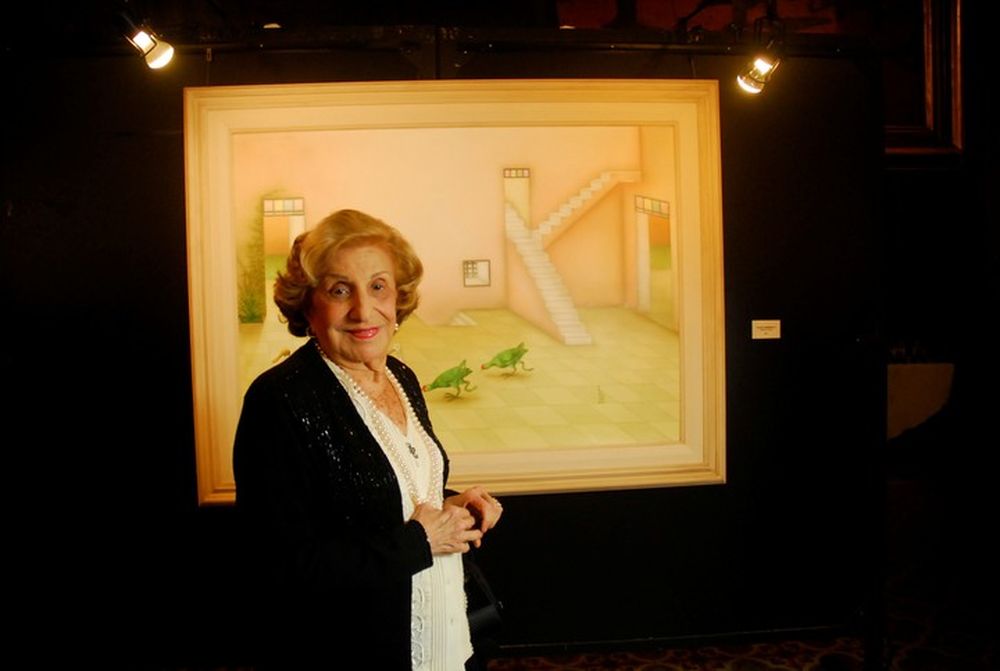
However, Natalia Kohen never gave up writing. In his creative universe, word and image were inseparable dimensions. His story “The Man with the Red Tie” is a luminous example of this dialogue between art and life, and inspired a ballet of the same name performed by Julio Bocca.
In 2009, the Legislature of the City of Buenos Aires distinguished her as an Outstanding Personality of Culture, recognition of a career that spanned more than six decades of artistic and literary production.
From those days in 2005, there remains a testimony that causes a lump in the throat. This is how she remembered the day she was admitted: “Claudia, my youngest daughter, came in with her key, along with her husband and six nurses dressed in white with a box of injections and a wheelchair. I thought I was dying. It was something very brutal. My daughter was in front of me, I was asking her for help and she was just looking at me. And my son-in-law shouted at me ‘you have to go because you are very sick’. The nurses must have noticed that I wasn’t an angry crazy person because I asked them to leave me for a little while, that I was very nervous, and they agreed. “Then they took me in an ambulance to Ineba (Buenos Aires Neuroscience Institute).”
And about her hospitalization: “My arrival was traumatic. I had put on a skin bag, it was quite cool. They left me in a place alone, I was terribly depressed and tired. I heard my daughters’ voices in another room. A nurse came, they gave me something and it seems that they put me to sleep. The next morning I woke up, still dressed in the bag, in a bedroom. It was a fairly regimented life, with times to get up, have breakfast… They medicated me as if I were sick, but I was healthy, so they were making an idiot of me. And one lives with sick people. There was a girl of about 35 years old and an eight-year-old mentality who kept crying and asking for her mother, people who screamed at night, someone who wanted to cut her wrists…”
Years later, a court ruling determined that Kohen was healthy and had been the victim of a diagnostic error. His property was restored, and his daughters publicly apologized. Natalia, with the temperance that had characterized her entire life, accepted forgiveness and recomposed the family bond.
André Itamara Vila Neto é um blogueiro apaixonado por guias de viagem e criador do Road Trips for the Rockstars . Apaixonado por explorar tesouros escondidos e rotas cênicas ao redor do mundo, André compartilha guias de viagem detalhados, dicas e experiências reais para inspirar outros aventureiros a pegar a estrada com confiança. Seja planejando a viagem perfeita ou descobrindo tesouros locais, a missão de André é tornar cada jornada inesquecível.
📧 E-mail: andreitamaravilaneto@gmail.com 🌍 Site: roadtripsfortherockstars.com 📱 Contato WhatsApp: +55 44 99822-5750