


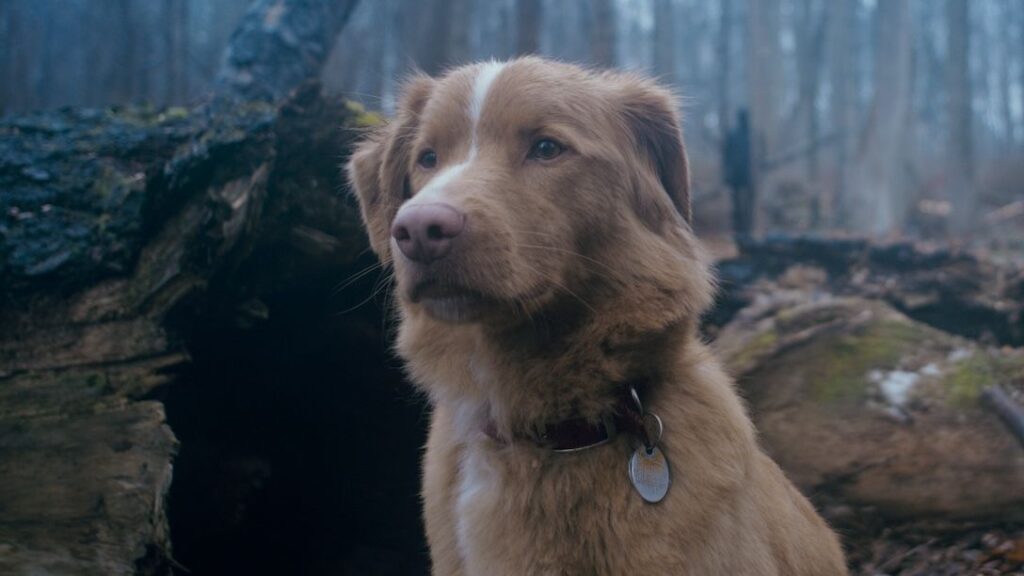
In Justine Triet’s film, Anatomy of a fallan overlooked character becomes central within the family dynamics: Snoop the dog. A pure and silent witness, he does not judge, does not manipulate, does not mystify, but invites the spectator to adopt his gaze, which does not pretend to solve the enigma but to pass through it, thus restoring to the film a dimension composed of different and often antithetical truths, made of fragility rather than certainties.
From this perspective the idea of a different cinema germinates, where the gaze of a dog can become a narrative device capable of reflecting the human without the friction of words. Exactly like it happens in the horror film Good Boy di Ben Leonbergwhich radicalizes this perspective, entrusting the sole point of view of the story to a dog and the only subjective one capable of restoring the disturbing depth of alienation.
The one between the protagonist of Good BoyTodd, played by Shane Jensen, and his dog, a beautiful Nova Scotia Duck Tolling Retriever by name Indyit is a very intense symbiotic relationship. Todd, after a difficult period and hospitalization, decides to leave the city and move away from everything and everyone to his deceased grandfather’s house in the countryside. Welcoming him, accompanied only by his dog Indy, is a dilapidated house, abandoned in the woods, a place that is not at all pleasant or hospitable, and which is feared to be haunted by ghosts. His sister Vera (Arielle Friedman), urges him to change his mind and reconsider his decision considering both his physical state, a chronic disease which led him to manifest significant respiratory symptoms, as well as the anomalous circumstances in which his grandfather was found dead.
The house as the epicenter of horror
The idea of moving to a remote place to rest becomes an isolation that is anything but therapeutic: apart from a few walks, Todd closes himself within the disturbing walls of his new home watching his grandfather’s old video cassettes and numerous horror films. In a short time Todd’s behavior becomes increasingly bleakhis health also worsens, and Indy begins to perceive that the same dark force that dwells in that house, and which probably killed Todd’s grandfather, is surrounding his master like a ravenous vulture.
In horror imagery, the home often takes on the role of narrative epicenter: a limited and well-defined space that amplifies the fears of its inhabitants and acts as a sounding board for their interiority and their sense of impotence. The house where Todd chooses alienation with his dog, is always lurking, guarded, predatory, darkand the supernatural forces that slide from one room to another are perceived by the dog in the form of small squeaks, night noises, thuds, screeches.
Evil through Indy’s eyes
His sensory experience it shapes our vision and the cinematic lens is totally aligned on the dog’s axis of gaze: through Indy the viewer learns to capture the invisible and translate many small signals, such as a smell, a shadow, a tremor in moments of fear, curiosity, affection, amazement. It is through these small gestures that the film reconstructs the closeness between Todd and his only stable interlocutor, underlining how the relationship with the animal is a magnifying glass for human trauma.

André Itamara Vila Neto é um blogueiro apaixonado por guias de viagem e criador do Road Trips for the Rockstars . Apaixonado por explorar tesouros escondidos e rotas cênicas ao redor do mundo, André compartilha guias de viagem detalhados, dicas e experiências reais para inspirar outros aventureiros a pegar a estrada com confiança. Seja planejando a viagem perfeita ou descobrindo tesouros locais, a missão de André é tornar cada jornada inesquecível.
📧 E-mail: andreitamaravilaneto@gmail.com 🌍 Site: roadtripsfortherockstars.com 📱 Contato WhatsApp: +55 44 99822-5750