
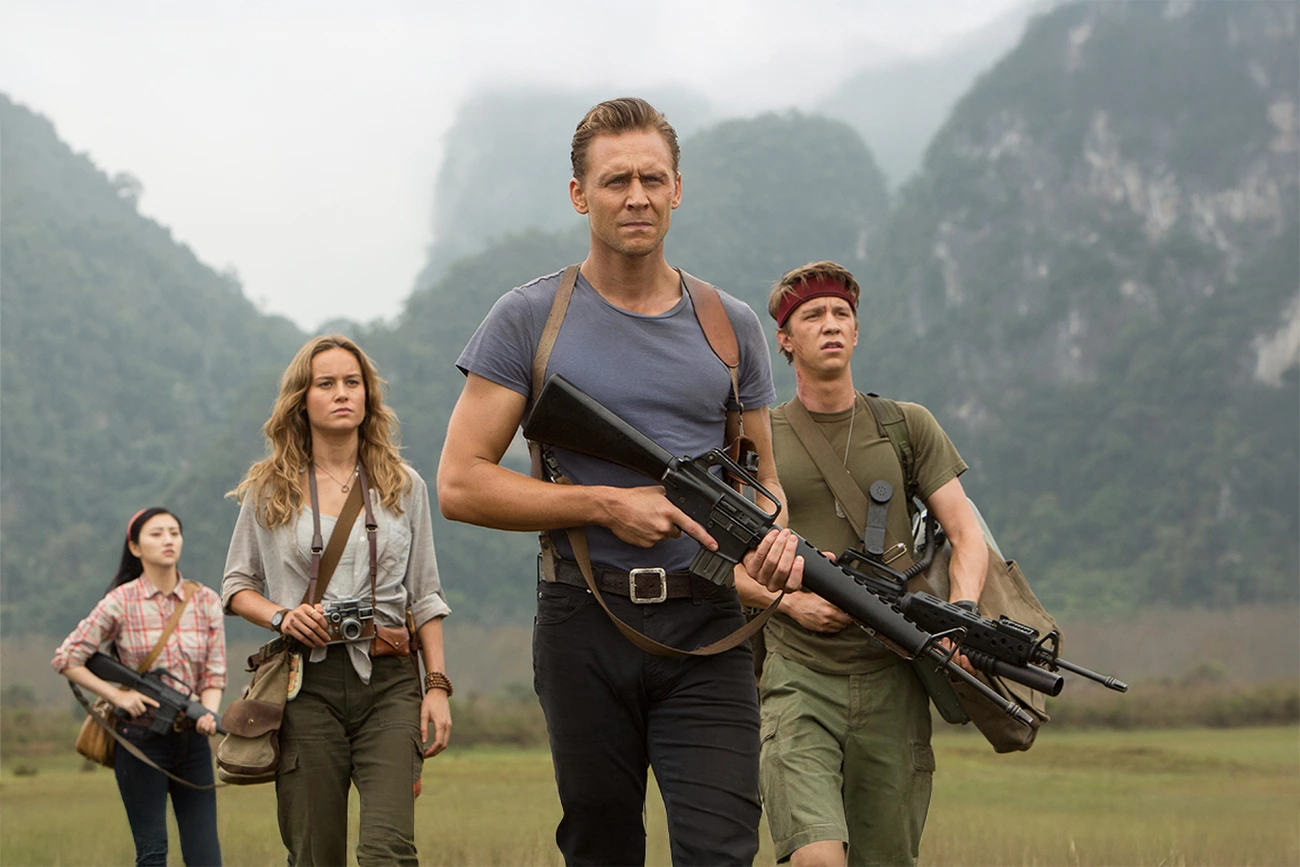
“Kong: Skull Island” is born from the ambition to revitalize the colossal imagery of the giant ape, but filtered through an aesthetic that combines nostalgia, pop delirium and veiled criticism of human arrogance disguised as science. Set at the end of the Vietnam War, the film transfigures the conflict into an allegory: imperialism replaces the battlefield and the jungle becomes a mirror of collective failure. The result is a curious hybrid between pulp adventure and political commentary, a film that alternates between dazzle and madness, aware of its own condition as an excessive spectacle.
The first half functions as a rite of passage. The crossing of the storm is not only literal, but symbolic: each character enters the island driven by a belief, the soldier by revenge, the scientist by glory, the photographer by truth, and everyone leaves reduced to the condition of intruders in a territory they will never understand. Jordan Vogt-Roberts films this confrontation as if he were dealing with a collective fever, between absurdity and hypnosis. The saturated visuals, the theatrical angles and the nostalgic track do not disguise the irony: American heroism, disguised as a scientific mission, is once again swallowed by a nature that does not submit to any discourse.
Kong, in turn, is the moral axis of chaos. What in other films would be a creature to be defeated, here it is a protective entity, guardian of an ancestral balance that the human presence insists on corrupting. The island, with its subterranean monsters and silent tribe, functions as a microcosm of an ancient order, where violence and harmony coexist in symmetry. By trying to map, bomb and dominate this space, men reproduce the same cycle that turned Vietnam into ruin; the colonial gesture, disguised as scientific curiosity, turns out to be suicidal. The film doesn’t need to explain this: just watch Kong’s gaze, simultaneously wild and lucid, to understand who the real invader is.
Even with sometimes caricatured dialogues and characters shaped into archetypes, the obsessed soldier, the stoic adventurer, the idealistic reporter, the film finds strength in form. Vogt-Roberts seems to understand that excess is part of the language: the visual exaggeration, the crazy colors and the almost cynical humor function as a self-criticism of the blockbuster itself. The comic tone, far from impoverishing, reinforces the idea that we are facing a fable about power and immodesty, where man always thinks he is the protagonist until he is reminded that he is just an extra on the stage of nature.
“Kong: Skull Island” is not intended to be a philosophical treatise, but the chaos it organizes is revealing. Amid explosions, giant creatures and unlikely heroism, there is a silent commentary on human arrogance and the fragility of the narratives we create to justify destruction. The film is entertaining, yes, and does so with technical competence and a pulsating rhythm, but it leaves an uncomfortable echo: perhaps the real monster is not in the jungle, but in those who insist on invading it, believing they own the world.
Film:
Kong: Skull Island
Director:
Jordan Vogt-Roberts
Also:
2017
Gender:
Action/Adventure/Fantasy
Assessment:
8/10
1
1
Fernando Machado
★★★★★★★★★★

André Itamara Vila Neto é um blogueiro apaixonado por guias de viagem e criador do Road Trips for the Rockstars . Apaixonado por explorar tesouros escondidos e rotas cênicas ao redor do mundo, André compartilha guias de viagem detalhados, dicas e experiências reais para inspirar outros aventureiros a pegar a estrada com confiança. Seja planejando a viagem perfeita ou descobrindo tesouros locais, a missão de André é tornar cada jornada inesquecível.
📧 E-mail: andreitamaravilaneto@gmail.com 🌍 Site: roadtripsfortherockstars.com 📱 Contato WhatsApp: +55 44 99822-5750