
(Motorsport-Total.com/Motor1) – If there is a cult film of the 1980s – or rather an entire film series – it is “Back to the Future”. Generations of viewers can hear the dialogues, even if many of them were not yet born in 1985, the year of the premiere.

© Motor1.com Manufacturer
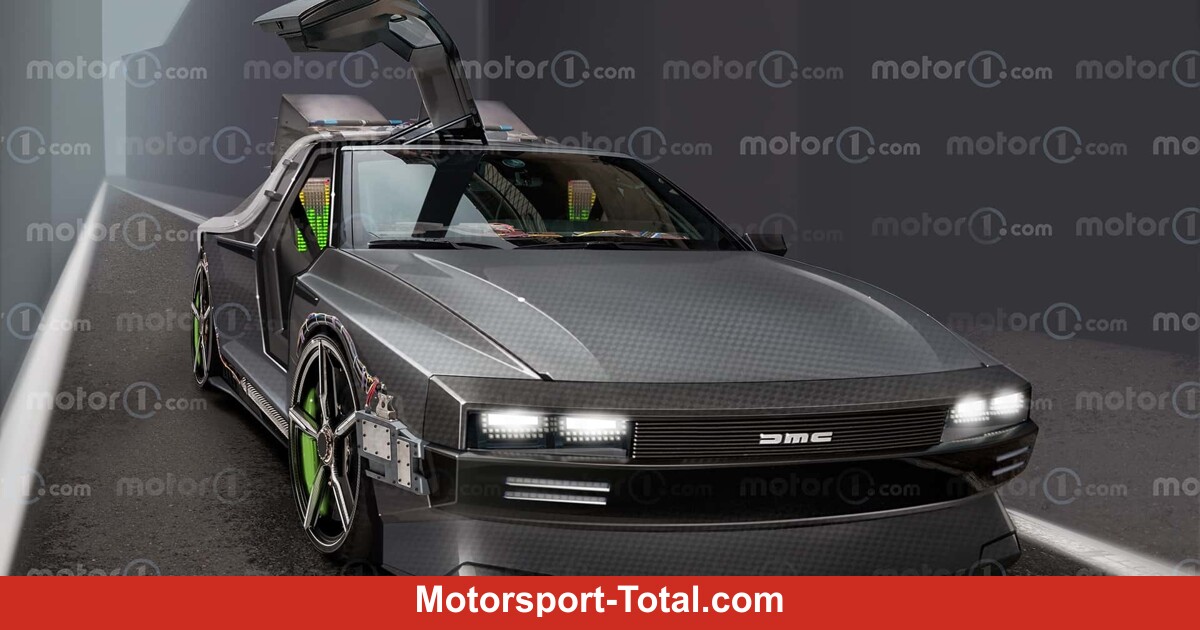
DeLorean from “Back to the Future 4” (2025) in the rendering from Motor1.com
Zoom
October 21, 2025 marks the 40th anniversary of its theatrical release. In Italy, for example, this anniversary is celebrated with film screenings, exhibitions and other events under the name “Ritorno al Futuro Day”. Although the film was released there on October 18, 1985, the date chosen was October 21 – the day on which the protagonists Marty McFly and Emmett “Doc” Brown travel into the future in the second part.
The focus of the trilogy is the DeLorean DMC-12, which Doc Brown converted into a time machine. Based on this, Motor1.com has designed a concept that shows what the DeLorean could look like in 2025 – intended for a hypothetical, “Back to the Future 4”. Which the team around Robert Zemeckis ruled out years ago.
The basis of the design remains the original DeLorean, designed in 1975 by Giorgetto Giugiaro for Italdesign. The typical wedge shape, the clear edges and the wing doors were retained, but interpreted in a modern way. The lines now appear more flowing, the wheel arches are wider, and the proportions correspond to today’s super sports cars. Despite all the changes, the basic idea remains the same: an unmistakable coupé with an unmistakable silhouette.
Photo series: DeLorean from “Back to the Future 4” (2025) in the rendering from Motor1.com
The body is no longer made of brushed stainless steel, but of visible carbon fiber, treated with metallic composites to increase electrical conductivity – a nod to the film’s “flux compensator” theory. The DeLorean is designed as a two-seater with a mid-engine and is significantly lighter than modern hypercars thanks to its extensive lightweight construction. The seats, rims and parts of the interior are also made of carbon.
The drive is no longer the original 2.8-liter PRV V6 with 132 hp, but a V8 biturbo plug-in hybrid from the Koenigsegg Gemera HV8. This unit produces 2,300 hp (1,500 from the combustion engine, 800 electrically) and delivers a maximum torque of 2,750 Nm. The electric motor, called the “Dark Matter E-Motor”, works on the axial flow principle and seems like a technical idea straight from Doc’s laboratory.
The energy is supplied by a 14 kWh battery, which can be charged via the reactor at the rear or via a power source – where “Mr. Fusion” was in the film. By the way, the original is a Krups 223 coffee grinder…
With a weight of around 1,600 kilograms, the DeLorean achieves a power-to-weight ratio of 0.69 kg/hp, better than many current super sports cars. The all-wheel drive with torque vectoring distributes the power between the axles and is shifted via the nine-speed Light Speed Tourbillon Transmission dual clutch transmission.
This means the DeLorean accelerates from 0 to 100 km/h in 1.8 seconds, reaches 200 km/h after 3.7 seconds and 400 km/h after 15 seconds. So the famous 88 miles per hour (141.6 km/h) required to travel through time would no longer be a problem. Marty would no longer have to say, “Doc, we need more running – the road isn’t enough!”
More from DeLorean:
This DeLorean DMC-12 is unusual in every way
Why are there 17 DeLorean DMC-12s piled up in this garage?!

André Itamara Vila Neto é um blogueiro apaixonado por guias de viagem e criador do Road Trips for the Rockstars . Apaixonado por explorar tesouros escondidos e rotas cênicas ao redor do mundo, André compartilha guias de viagem detalhados, dicas e experiências reais para inspirar outros aventureiros a pegar a estrada com confiança. Seja planejando a viagem perfeita ou descobrindo tesouros locais, a missão de André é tornar cada jornada inesquecível.
📧 E-mail: andreitamaravilaneto@gmail.com 🌍 Site: roadtripsfortherockstars.com 📱 Contato WhatsApp: +55 44 99822-5750