


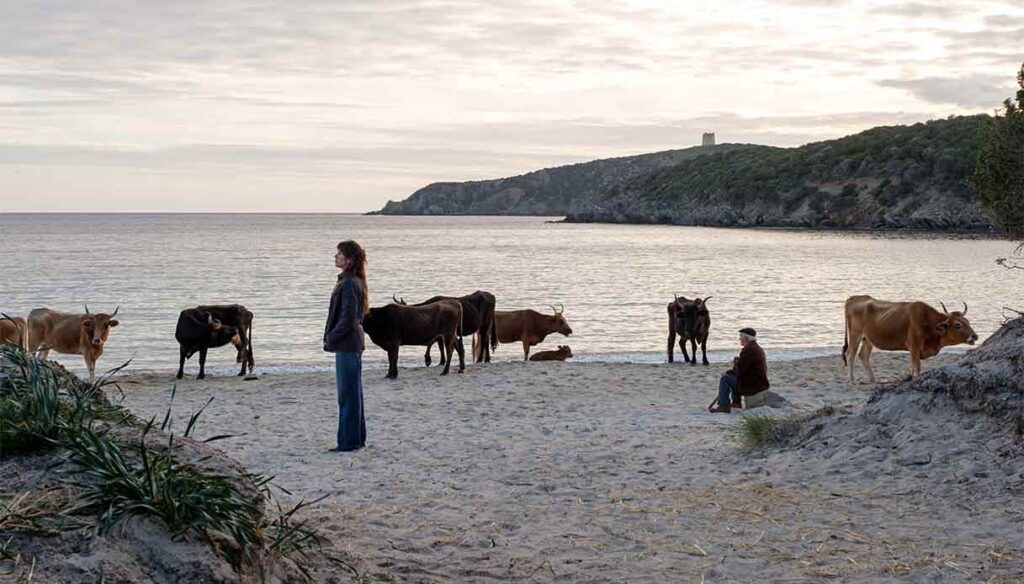
Riccardo Milani’s new film Life Goes Like This tells the true story of a Sardinian shepherd, which opened the Rome Film Festival 2025, in Italian cinemas from 23 October 2025. Starring an all-Italian stellar cast, including Diego Abatantuono, Virginia RaffaeleAldo Baglio and Geppi Cucciari, is set in a still rather uncontaminated corner of southern Sardinia.
What is it about Life goes like this
A still uncontaminated stretch of coast in southern Sardinia is the protagonist of the story which sees two completely different worlds collide: one, made of sheep farming, and the other, that of the real estate business. And it’s the story of Efisio Mulas (played by Giuseppe Ignazio Loi), a solitary Sardinian shepherd, silent guardian of a time that seems to no longer exist. He has always lived there, with a farmhouse practically on the street beach – which belongs to him but which is invaded by tourists in the summer – between the sea and his animals, in the small house where he was born.
On the other side there is Giacomo (Abatantuono), President of a powerful real estate group, symbol of an Italy launched towards the future and who is determined to transform that coast into a luxury resort. At his side is Mariano (Aldo Baglio), construction site manager and practical man, who has the task of convincing Efisio to give up that last strip of land. Between the two there is Francesca, daughter of Efisio (Raffaele), torn between change and belonging to her land. When Efisio refuses yet another millionaire offer, the negotiation turns into a legal battle in which Giovanna (Geppi), a judge born and raised in those places called to resolve the conflict, enters the scene. Strengthened by the value of his choices and the memory of those who came before him, Efisio knows that sometimes, precisely because “life goes like this”, you have to stop and decide for yourself where to go. How will it end?
Where Life Goes Like This was filmed
Anyone who knows that strip of beach in Sardinia also already knows the ending. For those who have never heard of it then, here is the real story and the real location. First of all, it is the true story of a Sardinian shepherd, Ovidio Marraswho defended his land from concrete because, for decades, he managed to say no to the aims of rich entrepreneurs, but who was also a symbol for the whole of Sardinia at the mercy of greedy unscrupulous builders. The director himself, Riccardo Milani, said that he had learned about this story after reading it in the newspapers and, since he had frequented that area of southern Sardinia, visiting the beach in question, he decided to shoot the film there.
Tuerredda beach
The beach in question is none other than the legendary Tuerredda Capo Teuladaone of the most beautiful beaches in southern Sardinia, iconic for its tip of fine white sand that flows into the blue sea. A corner of the Indian Ocean in the Mediterranean, where the water takes on dozens of varying shades from green to turquoise. Coveted every summer by many tourists, to visit it for a few years it is necessary to reserve a place: it can accommodate a maximum of 1,100 people, 371 places are reserved for the two bathing establishments and 729 for the free beach.
Tuerredda beach is much loved by tourists, above all thanks to its shape. In fact, it is sheltered from the mistral, which is an almost constant protagonist in Sardinia, consequently the sea is almost always calm, perfect for those who spend their holidays with children, who can therefore swim safely, or for those who love diving with a mask, discovering the sandy seabed rich in marine fauna or swimming up to theislet that lies in front. Basically, that resort they wanted to build on the shepherd’s land was never built, which is why this beach is still the paradise we know today. A little crowded in summer obviously, but if you happen to be there during the year it’s a real Eden.
The locations in Cagliari
Filming also took place in Cagliari. Among the recognizable places in the film is via Ancona, inside a law firm housed in a modern building. Those who know the city will immediately see the ancient neighborhood Castello (Casteddu de Susu; in Sardinian), the main of the four historic districts of the city which stands in a predominant position, on a hill, about one hundred meters above sea level. And then the vast Piazza Repubblica, created in the 1950s, when the city was experiencing a phase of rapid expansion and modernisation. The square was conceived as part of a broader urban redevelopment plan, aimed at creating new public spaces and improving the city’s traffic system.


André Itamara Vila Neto é um blogueiro apaixonado por guias de viagem e criador do Road Trips for the Rockstars . Apaixonado por explorar tesouros escondidos e rotas cênicas ao redor do mundo, André compartilha guias de viagem detalhados, dicas e experiências reais para inspirar outros aventureiros a pegar a estrada com confiança. Seja planejando a viagem perfeita ou descobrindo tesouros locais, a missão de André é tornar cada jornada inesquecível.
📧 E-mail: andreitamaravilaneto@gmail.com 🌍 Site: roadtripsfortherockstars.com 📱 Contato WhatsApp: +55 44 99822-5750