
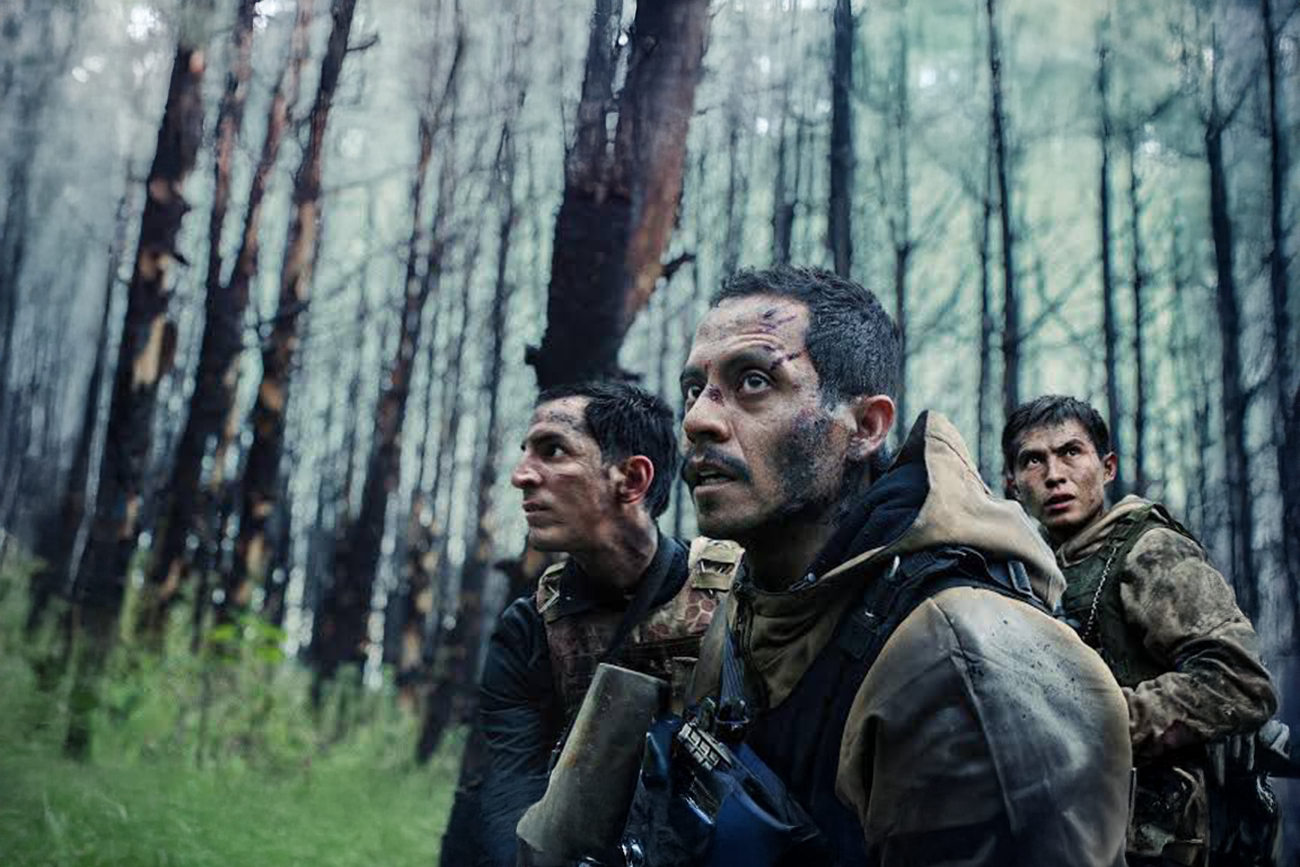
The narrative is based on a simple principle: when violence becomes routine, there is little room for easy heroism. “Contra-Ataque”, with Luis Alberti and Noé Hernández in the main cast and directed by Chava Cartas, follows a group of agents who, after a successful mission, become hunted by a cartel determined to retaliate. The film chooses the route of functional realism, occupying narrow streets, warehouses and stretches of road with the rigor of someone who calculates distances, entrances and exits, always avoiding dispersion.
The plot progresses as a sequence of short-term decisions: advance, hold position, extract wounded, change route. This logic appears clearly in the design of the spaces. The camera prefers close but not cluttered shots; the assembly preserves axis and direction; the viewer understands where each character is and why they move. When the chase pushes the group into open areas, the film alternates high and low points of view to locate weapons, vehicles and obstacles, avoiding the addiction of multiplying angles that only disorientate.
Sound reinforces this readability. Shots have body and variation depending on the environment; engines announce danger before entering the frame; Brief pauses between bursts serve as a marker for the next action. There is no insistent track trying to manufacture intensity. The tension arises from the contrast between noise and silence, the expectation of a lateral attack, the fear that the ammunition will run out. Instead of empty stylization, there is a concrete record of what it means to operate under siege, with limited supplies and little margin for error.
The performances follow this proposal. Luis Alberti is a pragmatic leader, attentive to calculating losses and team morale. His face carries exhaustion without theatricality, and authority is asserted through the ability to decide under pressure. Noé Hernández adopts minimal gestures and a firm presence, avoiding charismatic villainy. Antagonism is imposed by real risk, not by speeches. Among them, supporting characters gain quick traits — a short joke, a habit, a way of holding a gun — that are enough for immediate identification amidst the constant movement.
The direction opts for a lean film, without parallel episodes or decorative subplots. This brevity comes at a price: secondary characters rarely receive biographical details, and some dialogues resort to military phrases. Still, narrative economics favors the consistency of the set of actions. Each sequence pushes the next with clear cause and effect, and the feeling of being trapped spreads as routes fail and options dwindle. The result is a route that remains consistent from the first to the last visible displacement, supported by technical choices that prioritize understanding.
The photography adopts earthy tones for exteriors and cold light in passing interiors, such as warehouses and corridors. The contrast marks the passage of the day and the accumulated fatigue, without seeking ornamental beauty. In specific aerial shots, the camera expands the tactical reading: it reveals roadblocks, possible escape routes, and the approach of pursuers. The resource appears parsimoniously and serves the understanding of the scenario, not exhibitionism. The same parsimony applies to digital effects, discreet enough not to steal attention from physical impacts and dust.
The film avoids glamorizing the crime. The cartel is shown as a persistent force, with resources and reach, but without a fetish. The focus is on the fragile position of the agents and the difficult choices that persecution imposes. When casualties occur, the camera records immediate consequences: loss of fire capacity, change of plan, improvised medical emergency. Violence has a cost and narrative repercussions, which increases the gravity of each advance. The border, treated as a tense landscape, functions less as a symbol and more as a terrain that shapes displacements, with its access, dust, traffic and surveillance.
The assembly deserves to be highlighted for the discipline with which it preserves lines of sight and reaction time. In hand-to-hand combat, cuts respect movement and allow you to follow strikes and retreats without confusion. In vehicle pursuits, the alternation between inside and outside keeps the scale of the risks understandable: speed, distance, cover. The film refuses the impulse to cover each action with multiple cameras just to inflate intensity. When the body and object move within the frame and the editing does not interfere, the visual impact comes from a direct and convincing cause.
Dramatic writing relies on cooperation between professionals under pressure. There is no room for heroic egos that distract from the mission. The group debates routes, discusses ammunition, repairs weapons as much as possible. There is a lack of memorable phrases because the lines serve decision making. This option reduces the recall of names and histories, but increases the credibility of collective functioning. The viewer follows a team trying to close gaps in a hostile environment, and this attention to small work provides the emotional axis of the film.
If there are limitations, they are the lack of greater social density and the few breaks to observe the surroundings in addition to the operational urgency. The presence of the cartel is constant, but the portrait of the communities affected by the conflict appears only in passing. Even so, the choice to concentrate the point of view on the persecuted professionals keeps the focus consistent and prevents dispersion. Interest does not diminish because the chase imposes new decisions at every corner, and the threat, always closer, changes priorities without resorting to artificial twists and turns.
“Contra-Ataque” offers a direct portrait of tactical action in adverse terrain, supported by spatial clarity, attention to sound and restrained performances. Chava Cartas’ direction remains faithful to the proposal of efficiency and focus, and the duo Luis Alberti–Noé Hernández gives face to a conflict in which every error weighs heavily. The production confirms that it is possible to compete with global action standards without inflating duration or effects. The consequence is a film that values the understanding of risk, preserves the logic of each step and ends with the echo of decisions that continue to take their toll after the last exchange of gunfire.
Film:
Counterattack
Director:
Chava Letters
Again:
2025
Gender:
Action/Thriller
Assessment:
8/10
1
1
Amanda Silva
★★★★★★★★★★

André Itamara Vila Neto é um blogueiro apaixonado por guias de viagem e criador do Road Trips for the Rockstars . Apaixonado por explorar tesouros escondidos e rotas cênicas ao redor do mundo, André compartilha guias de viagem detalhados, dicas e experiências reais para inspirar outros aventureiros a pegar a estrada com confiança. Seja planejando a viagem perfeita ou descobrindo tesouros locais, a missão de André é tornar cada jornada inesquecível.
📧 E-mail: andreitamaravilaneto@gmail.com 🌍 Site: roadtripsfortherockstars.com 📱 Contato WhatsApp: +55 44 99822-5750