


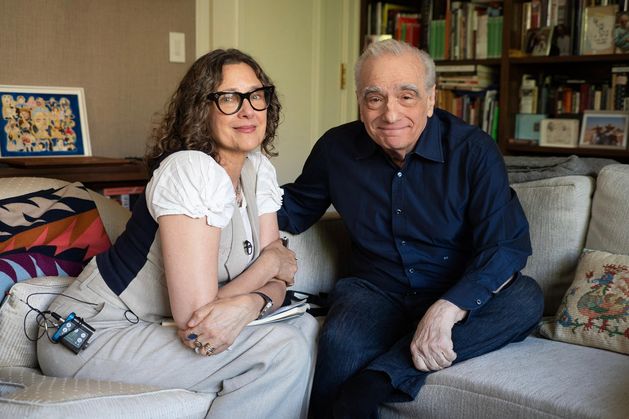
Legendary director Martin Scorsese talks about how his movie-making obsession kept him from his kids and his near-death experience after overdosing on drugs
I was too young to see it when it first came out in 1976, so this would have been about three years later. It completely blew me away. I’d never seen a film like it before.
From the opening shot of a yellow taxi cab gliding in slow motion through a vividly coloured, morally decaying New York City, accompanied by Bernard Herrmann’s incredible saxophone-driven score, alternately melancholy and menacing, to Travis Bickle’s surreally violent climactic killing spree, it was thrilling and mesmerising.
I’ve watched Taxi Driver I don’t know how many times since and it still thrills and mesmerises me. It’s a measure of the thoroughness of Rebecca Miller’s brilliant Mr. Scorsese (Apple TV+, all five episodes Friday, October 17), a “film portrait”, as it’s subtitled, of America’s greatest living filmmaker, that it gives me a fresh way to look at a film I love and imagined I knew inside out.
In the second episode, Scorsese illustrates how he conveyed the sense of troubled Travis’s isolation from the world around him in a two-hander scene with Robert De Niro and Cybill Shepherd, who played Betsy.
Whenever Betsy is speaking, Travis is always in the frame with her. Whenever Travis is speaking, it’s always him alone. It’s the kind of small, enriching detail you don’t notice, yet can’t stop noticing once it’s been pointed out.
We need your consent to load this Social Media content. We use a number of different Social Media outlets to manage extra content that can set cookies on your device and collect data about your activity.
For lovers of the 82-year-old director’s work, or indeed anyone interested in the craft of real filmmaking, this is five hours of heaven. Miller, who’s married to Daniel Day-Lewis (who starred in Scorsese’s The Age of Innocence and Gangs of New York) and is a first-rate director in her own right, takes a pretty conventional documentary approach to the story of a man whose continually surprising body of work is easily the least conventional of any major Hollywood director.
The extensive use of split-screen is about as elaborate as the directorial flourishes get. Miller doesn’t need to try anything fancier when she has such a rich seam of gold to draw from.


Scorsese gives great insight into the making of ‘Taxi Driver’. Photo: Getty
Not just the hours of interviews with Scorsese, who’s a great talker, but also clips from the films, behind-the-scenes footage, outtakes, rare photographs, home movies, archive interviews and a dazzling line-up of contributions from many of the key people in Scorsese’s creative and personal lives.
De Niro, Day-Lewis, Jodie Foster and Leonardo DiCaprio are here. So is Scorsese’s film editor of five decades, Thelma Schoonmaker, as well as Steven Spielberg, Brian De Palma, Spike Lee, screenwriters Paul Schrader and Jay Cocks, producer Irwin Winkler and Nicholas Pileggi, whose book on Henry Hill was the basis for Goodfellas.
One of Scorsese’s ex-wives, Isabella Rossellini, and his three daughters, Cathy, Dominica and Francesca, also appear.
When it comes to being self-critical, Scorsese is unforgiving about his personal failings
Some of the most enjoyable – and funniest – parts are when Scorsese and his old pals from his childhood in New York’s Little Italy sit around a restaurant table, reminiscing about their wild youth, in which street violence was an everyday occurrence.
The brother of one of them, Salvatore Uricola, known back in the day as Sally Gaga, was the model for De Niro’s hotheaded Johnny Boy in Mean Streetswhich is set in Scorsese’s old neighbourhood and was the film that put him on the radar.
We need your consent to load this Social Media content. We use a number of different Social Media outlets to manage extra content that can set cookies on your device and collect data about your activity.
When it comes to being self-critical, Scorsese is unforgiving about his personal failings. He’s frank about how his obsession with work meant he was barely there for his two older daughters when they were growing up (they nonetheless get along fine) and his excessive drug-taking in the 70s.
By the end of the decade, his habit landed in him in hospital and staring death in the face. It was De Niro who pulled him back from the brink by suggesting they needed to make a particular film together. It was Raging Bull.
The first two episodes, especially, do an outstanding job of telling us how Scorsese’s relationship with Catholicism (he briefly studied to be a priest) and his obsession with moral choices echoes throughout his work.
This is the definitive word on one of film’s great masters and a must-see.
Rating: Five stars


André Itamara Vila Neto é um blogueiro apaixonado por guias de viagem e criador do Road Trips for the Rockstars . Apaixonado por explorar tesouros escondidos e rotas cênicas ao redor do mundo, André compartilha guias de viagem detalhados, dicas e experiências reais para inspirar outros aventureiros a pegar a estrada com confiança. Seja planejando a viagem perfeita ou descobrindo tesouros locais, a missão de André é tornar cada jornada inesquecível.
📧 E-mail: andreitamaravilaneto@gmail.com 🌍 Site: roadtripsfortherockstars.com 📱 Contato WhatsApp: +55 44 99822-5750