


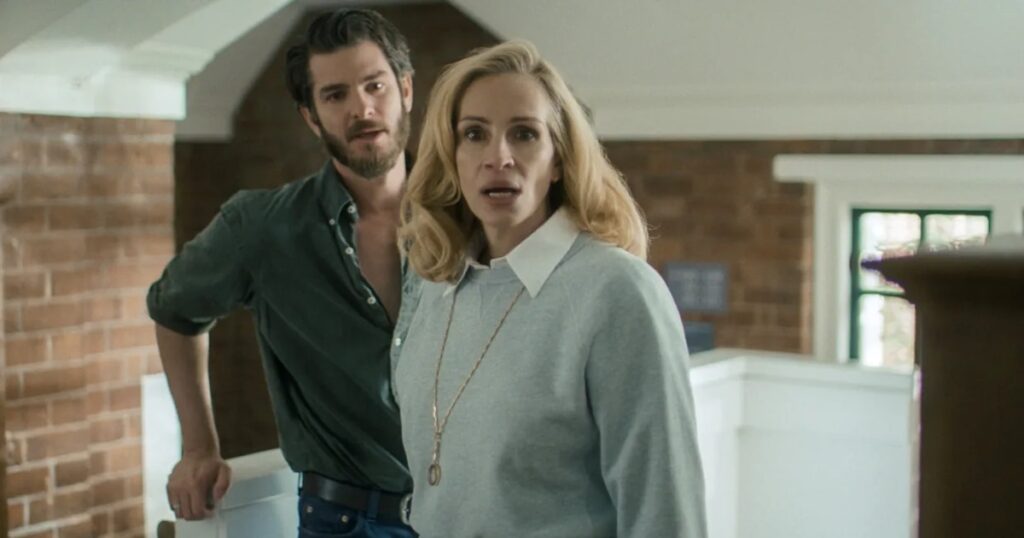
At the last Venice Film Festival, the Italian-born director Luca Guadagnino presented his latest film, titled After the Hunt and which in Spain has been translated as witch hunt.
Starring by Julia Roberts (who had not played a role with such substance in a long time), the new job of the head of Call Me by Your Name It sparked a tense debate within the framework of the contest that will surely resonate with viewers when the film is released, which lands on Spanish theaters this Friday, October 17.
The first ‘red flag’ appears in the credits, whose font corresponds to the one used Woody Allen throughout his entire career. Quite a declaration of intentions on the part of the director who seems to want to set the tone for the Me Too and its consequences regarding the cancel culture.
At the center of the plot is Alma Anville, a philosophy professor at Yale University, played by Roberts, who will find herself caught at a personal and professional crossroads. The story begins when one of its most outstanding students, played by Ayo Edebiriaccuses a colleague, played by Andrew Garfieldof rape. The student, not feeling supported by her mentor, will blame her for not believing her, while the accused professor will also reproach Alma for her lack of support, convinced of her innocence. This conflict places the protagonist at the center of a network of loyalties, doubts and secrets, where each decision seems doomed to have irreparable consequences on the respective professional careers of those involved.


The script, written by the debutante Nora Garretdelves into the gray areas of consent, the ‘revictimization’ and the complexity of power relations. The film raises the possibility that a victim of abuse can be, at the same time, a mediocre student or even a cheater, without this diminishing the seriousness of the violence suffered. It also explores how ‘sorority’ can break at the most critical moments and how the new generations, represented by the Generation Zthey challenge and at the same time repeat the mistakes of their predecessors. “Not everything is supposed to make you feel comfortable,” the character Alma states in one scene, a statement that sums up the uncomfortable and provocative spirit of the film.
witch hunt It begins with the phrase: “It happened at Yale” and then immerses us in the atmosphere elitist and posh from the university in a evening in the protagonist’s house where everyone seems to want to be smarter than the other while they quote philosophers (Hegel, Heidegger, Nietzsche, Arendt, Freud or Adorno) and drink alcohol with bare feet.
Julia Roberts’ character talks about Michel Foulcault in his classes, focusing on the concepts of ‘collective morality’ or the ‘ethics of society’, something that Guadagnino will use to talk about ‘woke’ culture and take him to his land premeditated controversy.
The problem is that the plot twists all the concepts so much that, in the end, it gives the impression that what the director intends is to place himself above the viewers and imply that he has the keys to an issue like Me Too, which, by the way, he is in charge of perverting to imply that women have taken advantage of the movement to take revenge on men and climb positions at their expense. A theory that will surely delight the so-called ‘manosphere’.
And the director handles material that is too delicate and incendiary for everything he proposes to be overlooked or for him to miss the point. And all this, furthermore, through a tone of intellectuality artificial as burdensome as it is deceitful that gives the proposal a leaden aura and, ultimately, self-condescending.
And Guadagnino, who is indeed smart, but not as smart as he thinks, uses off-screen and allusions to generate doubt, but, in reality, he does not stop going round and round about the same concepts, creating a radioactive intrigue that we know will explode to end up talking about how the female empowerment produces monsters, which is still the most derogatory treatment towards women.
witch hunt It has some notable peculiarities. Guadagnino likes to play with cinematographic language and, in that sense, the film becomes a space to experiment with editing and create scenes that are disconcerting at all times. The only downside is that all these tricks are very tramposas.
Another characteristic that the film is supposed to have is wanting to challenge the viewer with its moral dilemmasso that he takes sides as the plot develops, something that actually ends up being a lie, because it leads us to an absolutely biased ending.

When you see this movie 139 minutes think: what an ability to condense all the conversation topics into such a clever plot. But as it goes on, you realize that you’re being manipulatedwhich is all part of a grotesque artifice to generate an opportunistic controversy.
As women continue to fight for their rights, this film takes advantage of them to call out the old stigmas of structural machismo. In the end, what Guadagnino proposes is something as stale as Trump’s messages: what it’s about here is winning or losing, regardless of the corpses you leave along the way.

André Itamara Vila Neto é um blogueiro apaixonado por guias de viagem e criador do Road Trips for the Rockstars . Apaixonado por explorar tesouros escondidos e rotas cênicas ao redor do mundo, André compartilha guias de viagem detalhados, dicas e experiências reais para inspirar outros aventureiros a pegar a estrada com confiança. Seja planejando a viagem perfeita ou descobrindo tesouros locais, a missão de André é tornar cada jornada inesquecível.
📧 E-mail: andreitamaravilaneto@gmail.com 🌍 Site: roadtripsfortherockstars.com 📱 Contato WhatsApp: +55 44 99822-5750