
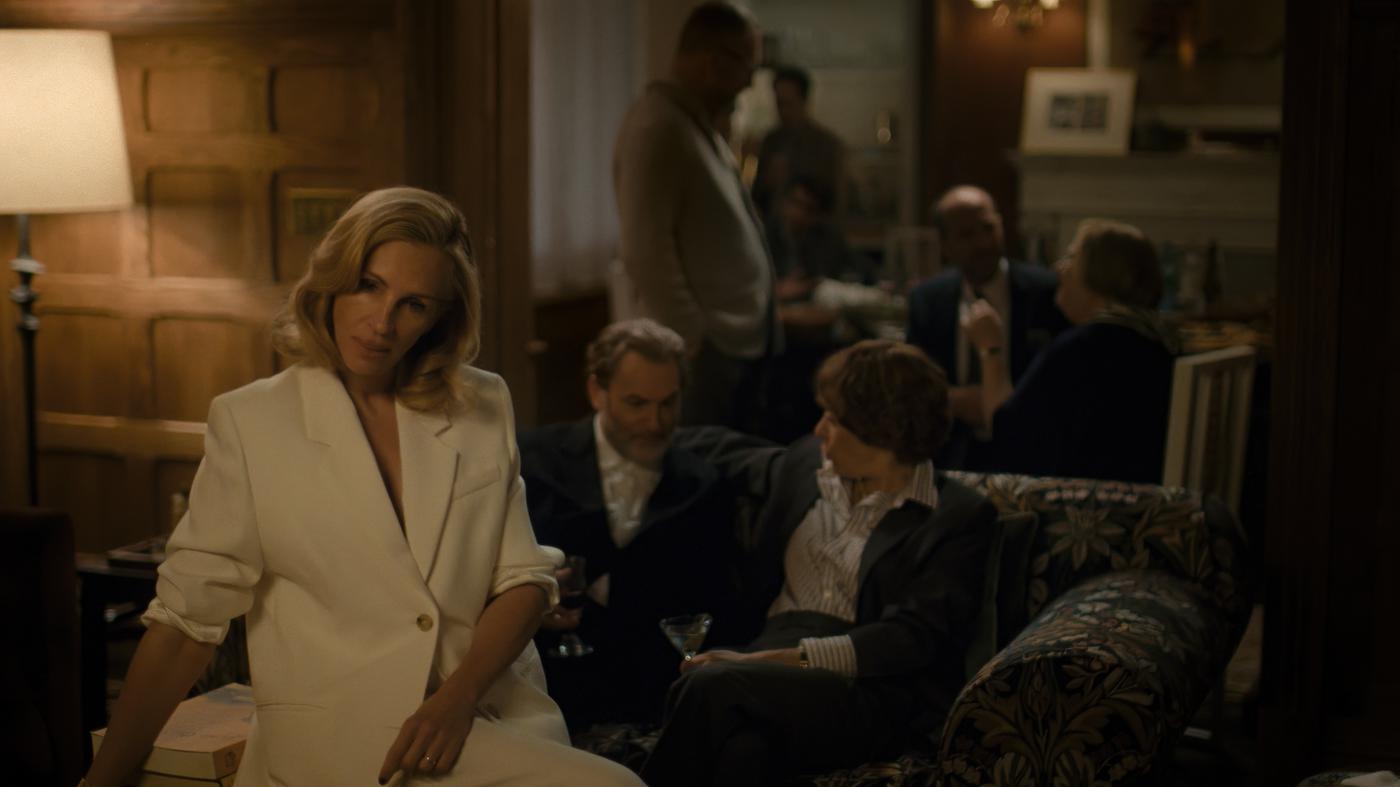
Hegel did not have his “little Hegel” under control and Freud was misogynistic anyway. These are the small talk topics of the intellectuals who have gathered for the soirée in the chic living room of philosophy professor Alma (Julia Roberts). The wine flows freely as Alma’s friend and colleague Hank (Andrew Garfield) fumes about “this superficial cultural moment.”
“Your entire generation is afraid of saying the wrong thing,” he accuses Alma’s favorite student, Maggie (Ayo Edebiri), an unwilling representative of Gen Z. “Since when is insulting someone a mortal sin?” Another student is certain: If the decision is to be made between Alma and Hank as to who will get the coveted professorship for life at Yale University, then Hank has a bad hand. After all, the “heterosexual, white, cis man” is an enemy image that everyone can currently agree on.
Who is more privileged?
We’re right in the middle of the topics Luca Guadagnino’s pseudo-provocative thriller “After the Hunt” is about: cancel culture, identity politics – and MeToo. After the party, a visibly drunk Hank walks Maggie home. The next day she tells Alma that a sexual assault had occurred. Hank, in turn, swears that Maggie made up the allegations because he asked her about alleged plagiarism in her doctoral thesis.

© Sony
Alma has to decide who she believes – and what she portrays to the outside world. The latter is more important because, and this seems to be a central message of Guadagnino’s film: In the world of elite universities, everyone is their own neighbor and Alma definitely doesn’t want to harm her chances of becoming a professor for life.
What really happened that night ultimately doesn’t matter – to Alma and apparently also to the director and screenwriter Nora Garrett.
A surprising number of topics are addressed with surprisingly little insight gained. Various forms of discrimination, for example, because Maggie is black and lesbian, but also very wealthy – her parents are major donors to Yale University. Hank, on the other hand, is the white, heterosexual cis man in question, but has fought his way up through his own efforts.
Now who is more privileged? An exciting question to which the film does not provide an answer, also because Maggie’s character remains undefined.
Recommended editorial content
Here you will find external content selected by our editors to enrich the article with additional information for you. Here you can display or hide the external content with one click.
I agree that the external content can be displayed to me. This means that personal data can be transmitted to third-party platforms. You can find more information about this in the data protection settings. You can find these at the bottom of our page in the footer, so you can manage or revoke your settings at any time.
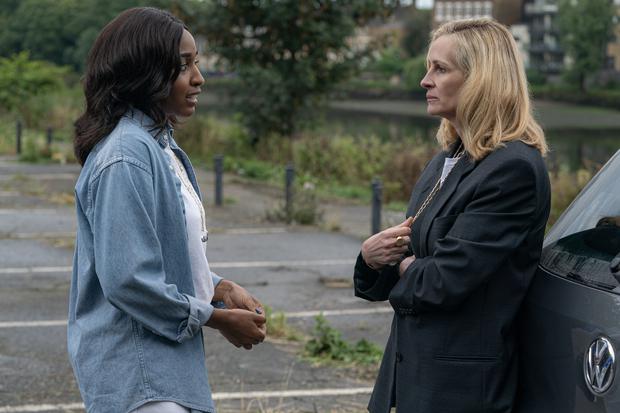
It is also about generational conflicts in feminism. Women like Alma and her friend, the psychologist and student representative (Chloë Sevigny), have asserted themselves in a misogynistic world, swallowing everything and having little understanding for their spoiled students who constantly complain. “Not everything is about your well-being,” Alma hurls at Maggie in a key scene.
Alma cares very little about her own well-being. Obsessed with the permanent job, she drinks too much, swallows pills and is plagued by stomach ulcers that make her writhe in pain and vomit. A seemingly contrived event from her past catches up with her now that she is in the middle of a MeToo scandal.
© Sony
Julia Roberts is strong as the protagonist, so overwrought that it can tear her apart at any time. Michael Stuhlberg is also convincing as her husband Frederik, who is apparently loyal to her but always analyzes her closely. But the acting cannot save this film, which is also difficult to reconcile with Guadagnino’s previous work.
Dystopian image of elite universities
The Italian director has made many great, sensual films about desire, from Call Me by Your Name to Bones and All, Challengers and Queer. The sticky fruit juice runs down the fingers, the sweat drips onto the camera, the blood swells in the name of eroticism.
© Sony
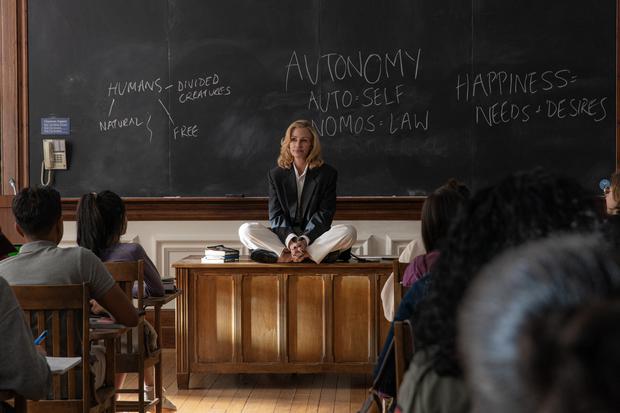
In contrast, “After the Hunt” seems downright anemic. The only thing that oozes from every scene here is Guadagnino’s apparent contempt for the world of Academia: The light is cold, the ethics teachers are morally corrupt, the Yale dean openly admits that he is concerned with appearance, not substance. And events have titles like “The Future of Jihadism is Female” – a picture of elite universities that couldn’t be more dystopian painted by the Trump camp.
There are also all sorts of meaningful details and recurring motifs: a loudly ticking clock, like a time bomb, or a constant focus on hands, which cameraman Malik Hassan Sayeed shows in close-up. We repeatedly see Frederik Alma placing two capsules on the nightstand next to her book, the “Buddenbrooks” by Thomas Mann, in the German original of course. One could benevolently interpret this production as meta-art, right down to the atonal soundtrack by Trent Reznor and Atticus Ross. As pretentious as the ivory tower that Guadagnino wants to portray in his film.
“After the Hunt” remains so entangled in ambivalence that the most provocative thing about the film is the opening credits: from the font to the actors in alphabetical order, it is reminiscent of the opening credits of Woody Allen’s films – a director who has not yet been canceled despite allegations that have been made. A troll move that doesn’t correspond to the tone of the following film at all. Unfortunately, he has nothing of substance to contribute about this “cultural moment”.
André Itamara Vila Neto é um blogueiro apaixonado por guias de viagem e criador do Road Trips for the Rockstars . Apaixonado por explorar tesouros escondidos e rotas cênicas ao redor do mundo, André compartilha guias de viagem detalhados, dicas e experiências reais para inspirar outros aventureiros a pegar a estrada com confiança. Seja planejando a viagem perfeita ou descobrindo tesouros locais, a missão de André é tornar cada jornada inesquecível.
📧 E-mail: andreitamaravilaneto@gmail.com 🌍 Site: roadtripsfortherockstars.com 📱 Contato WhatsApp: +55 44 99822-5750