
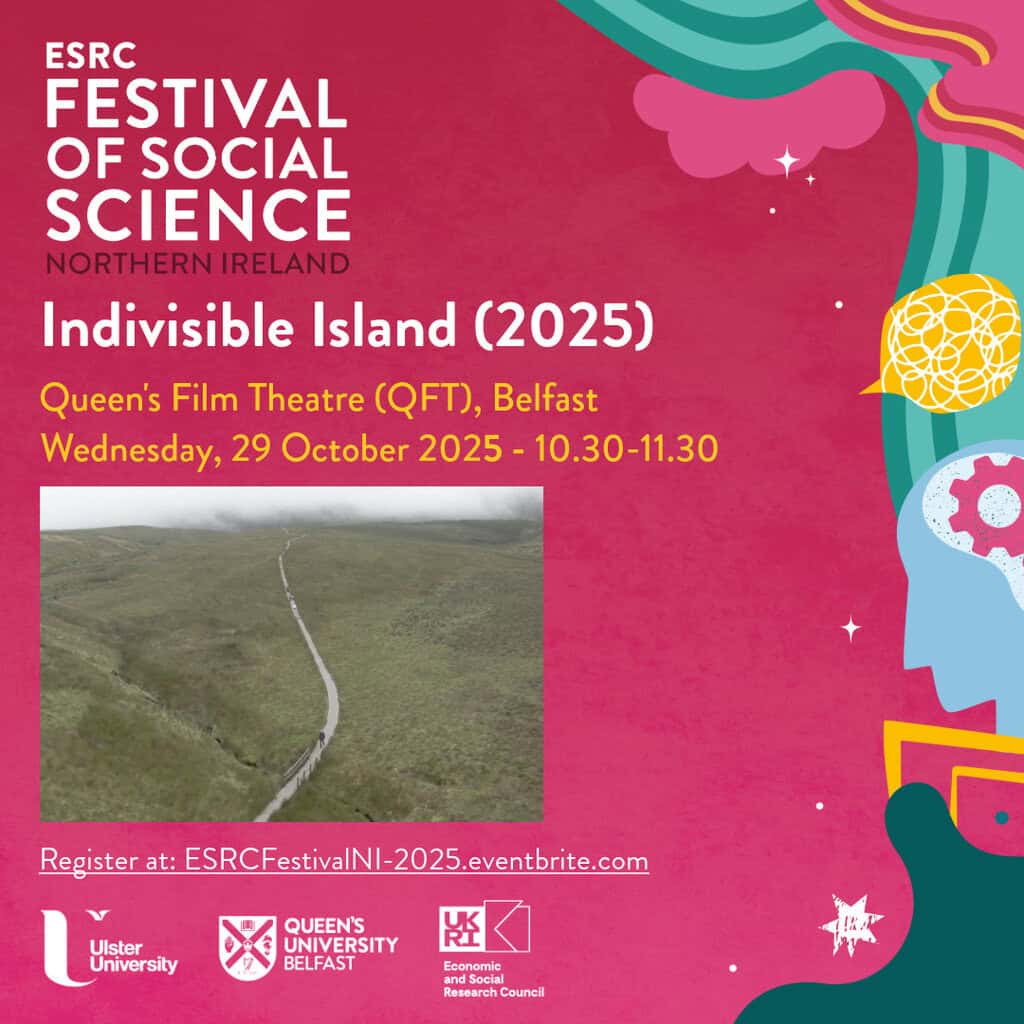
Gavin Turnbull (Director, Co-producer); Cathal McCall (Writer, Co-producer)
Orson Wells’ 1958 masterpiece Touch of Evil is set in a Mexico/USA border town. The film is structured around the joisting between the ‘good, moral Mexican cop’ Mike Vargas, played by a mahogany painted Charlton Heston, and the ‘bad, corrupt US cop’, the run out of road Hank Quinlan, played by Wells himself.
And yet, as borderlanders ourselves, we can’t help siding with the ‘you gotta lay of the candy bars’ Hank, not least when the self-righteous Vargas declares “all border towns bring out the worst in a country”. All the more so when it’s Marlene Dietrich’s character, Tana, chastising Hank about his obese physical state.
Our film documentary Indivisible Island (2025), in part, features some of the best cross-border work in Ireland’s border towns and regions: from Creative Spark in Dundalk, a vibrant cross-border creative hub; to the wildly popular Stairway to Heaven – officially known as the Cuilcagh Boardwalk Trail – that stretches across the Cuilcagh Mountain on the Fermanagh/Cavan border. Bandit Country it is known to some, a powerhouse of the Indivisible Island it is for others.
The film’s overarching objective is to interrogate countervailing ideas of the ‘divided Irish nation’ on the one hand, and that of the Indivisible Island on the other.
It charts the changing nature of the Irish border over the course of its century of existence. The Boundary Commission (1925) is an important initial staging post since it was tasked with confirming the new border though its recommendations never saw the light of day. Decades of border consolidation followed as the two governments on the Island sought to build their respective territorial jurisdictions and public administrations. This territorial severance was keenly felt in borderland communities where connectedness was displaced by creeping North/South disconnection.
But even worse was to come for borderlanders. A hard security border became entrenched during ‘The Troubles’ from the 1970s to the 1990s with borderscape British security watchtowers, checkpoints on key arterial cross-border routes, secondary roads bollarded or blasted, and bridges bombed.
Then came the debordering turn. The 1992 Treaty of the European Union signalled the beginning of the end for the border’s infrastructure with customs posts deemed surplus to requirements. Thereafter, the 1998 Belfast/Good Friday Agreement laid the groundwork for the eventual dismantlement of the British Army’s border security apparatus though it is known that the then Prime Minister Tony Blair had to overcome resistance from the British military establishment.
But the story of the border doesn’t end there. Brexit, the push for a referendum or ‘Border Poll’ on a ‘United Ireland’, the rise of far-right agitators and political movements in Britain and Ireland, and the re-emergence of anti-colonialist mobilisation on the Island of Ireland as a potent ideological clarion call for the Indivisible Island, have presented a vista of further twists and turns for the Irish border.
One hundred years of the changing physical manifestation of the border reflects its geographically unwieldy, contradictory and absurd 300km trajectory through towns, townlands, fields, bogs, loughs, and some homes.
For our film we prioritise insights provided by academics, creative writers, activists, and community workers. Additionally, as well as contributions from the border region, we also chose to film as far away from the border on the Island as it’s nearly possible to be: Cork. This approach is intended to provide wide and penetrative commentary on the Irish border, the ‘divided nation’, and the idea of the ‘Indivisible Island’.
The film recognises the oppositionality of the Ulster British community in Northern Ireland to questions relating to the Irish nation and the ‘Indivisible Island’. However, these are Ulster British concerns deserving of their own documentary treatment, as does another one examining the conundrum of the ‘British and Irish’ position. This film is focused on the Irish nation, the Indivisible Island and its historical and contemporary travails and ideals, and its future.
The Irish nation and Irish national identity is a complex rubric that is filled with sharp divisions in itself. However, a student of nations, nationalism and national identity will recognise that there is an abiding guiding principle: that the Irish national imagined community and the territory of the Indivisible Island are entwined.
For sure, those who claim an Irish cultural identity while prioritising a territorial national affiliation to Britain, the United States of America, Mexico, Australia, Aotearoa or anywhere else have a claim on Irishness. A key question for an Irish cultural identity, however, is its position on the question of the divided nation and the ‘Indivisible Island’.
To provoke comment on Irish national identity and the ‘Indivisible Island’ we walked around Cork with our poster ‘Michael Collins, Cork TD, Armagh MP’. Older people had an opinion that was invariably predisposed to both. Like Dan Breen, they all loved Collins; they all wanted a United Ireland. However, young people that we met on our rounds were non-committal. But perhaps that is because the filmmakers themselves were once young but are no longer so, and not from Cork.
Border towns don’t ‘bring out the worst in a country’. Rather it is the border itself, constituted as a line of separation, conflict, security, malevolence, exploitation, and fraud, that brings out the worst in a country.
‘Indivisible Island’ asks: “where do we, as a country, go from here?”.
See ‘Indivisible Island’ on Wednesday 29 October at 10.30am at the Queen’s Film Theatre, as part of the ESRC Festival of Social Science in NI 2025. Click here to register for your ticket.

QPol is the ‘front door’ for public policy engagement at Queen’s University Belfast, supporting academics and policymakers in sharing evidence-based research and ideas on the major social, cultural and economic challenges facing society regionally, nationally and beyond. Website: qpol.qub.ac.uk Email: (email protected)
Discover more from Slugger O’Toole
Subscribe to get the latest posts sent to your email.

André Itamara Vila Neto é um blogueiro apaixonado por guias de viagem e criador do Road Trips for the Rockstars . Apaixonado por explorar tesouros escondidos e rotas cênicas ao redor do mundo, André compartilha guias de viagem detalhados, dicas e experiências reais para inspirar outros aventureiros a pegar a estrada com confiança. Seja planejando a viagem perfeita ou descobrindo tesouros locais, a missão de André é tornar cada jornada inesquecível.
📧 E-mail: andreitamaravilaneto@gmail.com 🌍 Site: roadtripsfortherockstars.com 📱 Contato WhatsApp: +55 44 99822-5750