
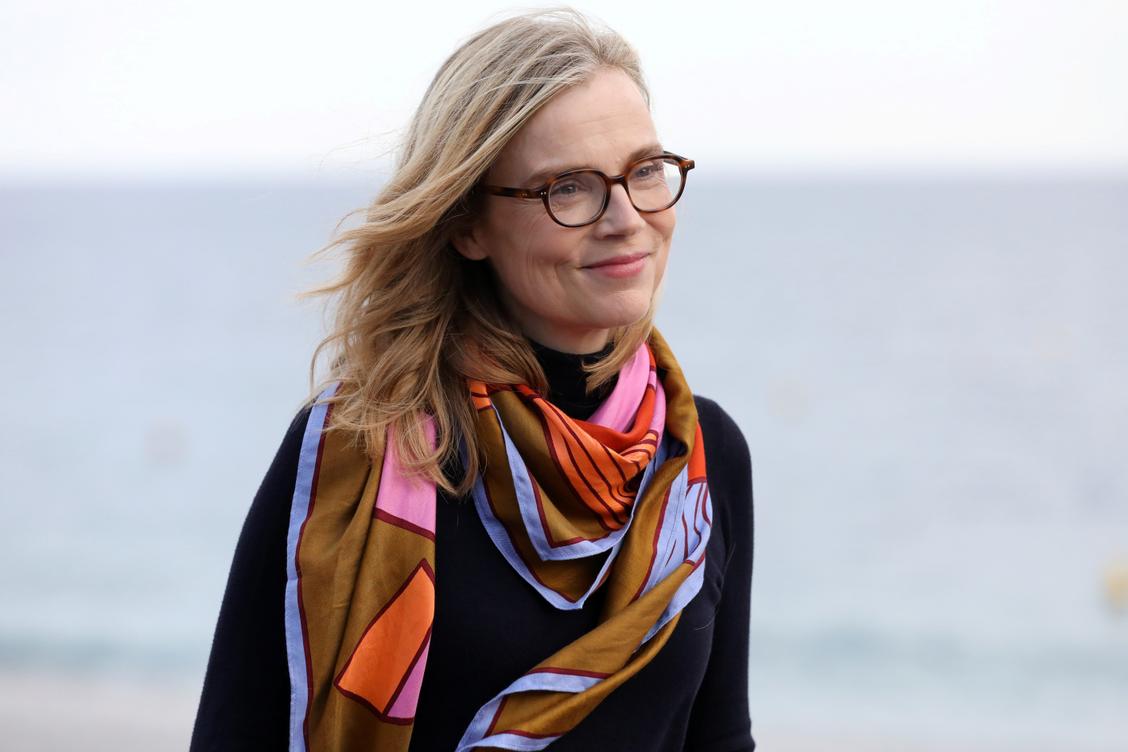
That Wednesday, at the beginning of October at the Le Negresco hotel, just before presenting a preview The Dreamers at the Cinéroman Festival, she appeared equal to herself. The light voice, almost embarrassed to attract the photographers’ lenses, elegant without forcing. For her debut as a director, Isabelle Carré adapts her first novel, The Dreamerslargely autobiographical. Released in 2018, it won the RTL-Lire Grand Prix and the L’Express – BFMTV Readers’ Prize.
From the point of view of a child and then a 14-year-old teenager, the actress evoked a family from the 1970s and 1980s, carried by a wind of freedom but weakened. The young girl sees her mother sink into anorexia, discovers her father’s homosexuality, before attempting to end her life after a heartbreak. She is then hospitalized in a psychiatric ward, where she is confronted with the distress of other young people.
Where does this desire to achieve come from?
Philippe Godeau, who had worked on the distribution of Remembering the beautiful things (by Zabou Breitman, 2002), came to see me when the book came out. He thought I had a perfect place in cinematic writing. This was not at all what I had in mind. For me, the ideal place of expression was the novel. Philippe came back to me several times, it took a while.
What finally convinced you?
When confinement arrived, in 2020, I saw that the figures concerning the despair of young people were soaring. Thereafter, they did not decline. It echoed this fragility that I had known.
I thought it might be interesting to put my experience in this psychiatric hospital in the 1980s into perspective with what young people can experience today. And that the film could be a tool to discuss the state of child psychiatry.
Was it difficult to expose yourself?
When the book came out, it was dizzying for me because it was a laying bare. Even if I wanted the word “novel” to be written, to the extent that I wanted to rely completely on my subjectivity. It was Shakespeare who said that the memories we invent are the most beautiful. I wanted this space of freedom, of creativity. On the other hand, as far as I am concerned, what revolves around the psychiatric hospital, I really experienced it.
The cold reality of this environment is counterbalanced by quite poetic shots…
I wanted gentleness, I didn’t want the image to be too dark, to see children being restrained, pricked with syringes, etc. It was essential for me that those who are in these hospitals at the moment, who are leaving them or who will leave them, do not feel stigmatized. If they see the film, I also want them to be able to tell themselves that there are solutions, whether it be art therapy, friendship or dialogue with family.
Was finding your “double” for the film a big challenge?
Elsa Pharaon, who is a very great casting director, having worked in particular with Olivier Nakache and Éric Toledano, showed me photos of around fifteen young girls for the role. I was struck by Tessa (Dumont Janod), I found that we were very similar. There was a video of her, in which she talked about her sadness at having to give up dancing, because she was too small and didn’t fit the criteria of the Paris Opera.
I saw myself again at the same age, giving up dancing. It was incredible, especially since there were also similarities in the way she expressed herself. Afterwards, fortunately for her, she doesn’t have my hyper-emotionality. She has a lot of modesty, something almost locked. The real challenge, for her and me, was finding how to allow her to express her emotions. We succeeded.
Our opinion
An actress named Elizabeth (Isabelle Carré) goes to a psychiatric ward to give writing workshops to young people. She quickly admits to them that she too has been there. We then move into his tormented adolescence.
The confinement and the penchant of caregivers of the time for heavy sedation are not hidden. But through a few saving characters, like this doctor played by Bernard Campan, her long-time accomplice on screen or in the theater, and the impeccable debutante Tessa Dumont Janod (who plays the teenage version of Elizabeth), Isabelle Carré manages to bring light and hope into her framework, while taking the subject of mental health seriously.
By and with Isabelle Carré. With Tessa Dumont Janod, Bernard Campan, Melissa Boros… Drama. 1:46 a.m. Our opinion: 3/5.

André Itamara Vila Neto é um blogueiro apaixonado por guias de viagem e criador do Road Trips for the Rockstars . Apaixonado por explorar tesouros escondidos e rotas cênicas ao redor do mundo, André compartilha guias de viagem detalhados, dicas e experiências reais para inspirar outros aventureiros a pegar a estrada com confiança. Seja planejando a viagem perfeita ou descobrindo tesouros locais, a missão de André é tornar cada jornada inesquecível.
📧 E-mail: andreitamaravilaneto@gmail.com 🌍 Site: roadtripsfortherockstars.com 📱 Contato WhatsApp: +55 44 99822-5750