


The symbolic universe of horror cinema has rarely granted man’s best friend more than a secondary role: warning humans of supernatural presence. ‘Good Boy’ (Filmin), debut feature of Ben Leonberg, dynamite this convention and, … In the process, it redefines the narrative perspective in the genre. Its premise is bold and simple: a haunted house story told exclusively from the a dog’s point of view.
The central idea of ’Good Boy’ was born in 2012, while the filmmaker was watching ‘Poltergeist’ for the umpteenth time. “That film begins with the family dog roaming the house, aware of the supernatural phenomenon before humans,” Leonberg recalls. “And I thought: Someone should make a haunted house movie told entirely from the dog’s point of view.” The director, a self-confessed creativity obsessive, wrote down the idea in his diary. «I always carry a notebook or write down on my phone. If I don’t write it, the idea is lost,” he confesses. That note was transformed, over time and with the collaboration of the coguionist Alex Cannon, in the premise of the film: the story of Todd and his dog Indy, who move to an isolated cabin where only the pet perceives a sinister presence.
The protagonist, Indy, is actually Ben Leonberg’s pet, a fact that turned out to be a huge plus. «I was able to film from his perspective and, at the same time, be the body of the human character (Todd). The scenes of affection are real: it’s me, and he really loves me,” she admits. However, filming with a dog involved a slow and patient process. «It was only my wife and I on the set, to keep it calm. We filmed for more than 400 days throughout three years. We achieved on average eight useful seconds per day,” he reveals. The “acting trick” was in the detail: “Sometimes we would make strange sounds to him, like ‘quack, quack, quack,’ and he would tilt his head. Then, with music and editing, it seemed like he detected something supernatural. “Actually, he was just playing with us.”

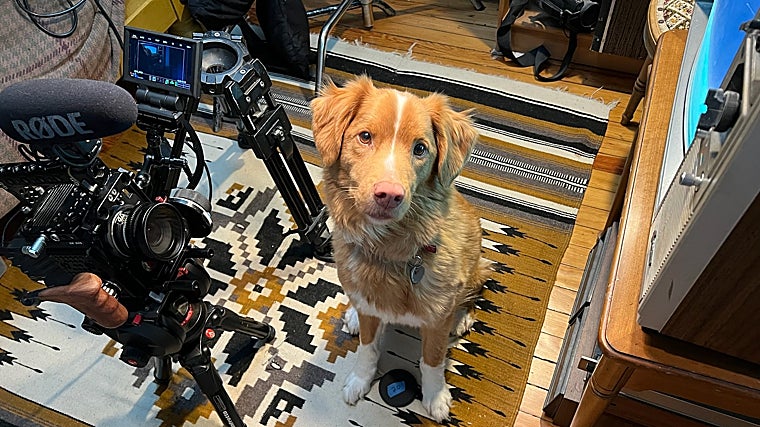
Indy, the protagonist of ‘Good boy’ on the set of the film
Is there anyone there?
From the beginning, the goal was to play with the conventions of horror cinema. “Haunted house movies often show the dog as the first to notice that something is wrong,” he explains. “But we wanted to turn it around: what if the whole story was told exclusively from his point of view?” Cannon proposed a key turn which gives the story a profound ambiguity: the film begins as a supernatural story, but little by little it suggests that the events could not to be paranormal, but “very real.” That tension connects with the emotional journey of Indy, whose mission is to protect his master from forces he does not fully understand. “It’s a story about loyalty and sacrifice, about what it means to keep fighting even when you don’t understand what,” says the director.
To maintain the authenticity of the canine perspective, the team imposed a series of strict rules inspired by Jack London, author of ‘White Fang’ and ‘The Call of the Wild’. «London said that his leading dogs they could not have abstract thought or internal monologues; “They could only be guided by the senses and basic reason,” he says. In the visual part, Leonberg – who also assumed the direction of photography – committed that each shot had to show Indy or be from his point of view. This restriction, he says, was both a challenge and a narrative tool: «The public He only knows what Indy sees. “That limitation creates a unique tension and mystery.”
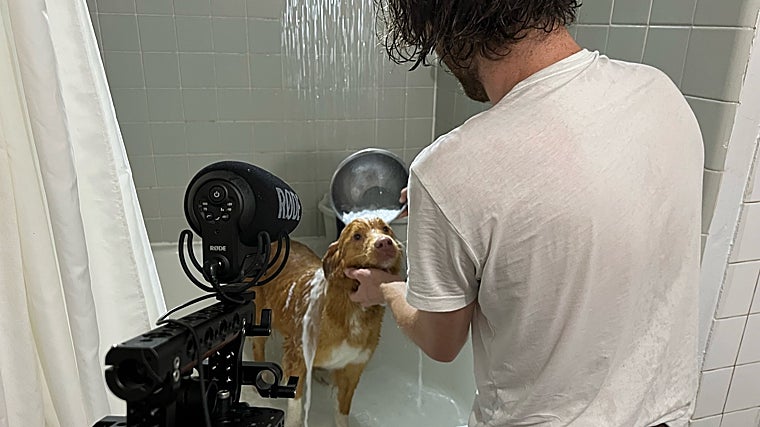
Indy, the protagonist of ‘Good boy’ on the set of the film
The director, also the film’s editor, confesses that many of Indy’s “performances” were built in the editing. «We use the Kuleshov effect to manipulate the viewer’s perception,” he explains. “A slight movement of the head, a step back… and, with the montage, it seems that Indy is afraid, and with that, the viewer should also feel afraid.” The soundtrack and sound design, by Brian Goodhart and Kelly Oosman, played a key role: “The audience shouldn’t consciously notice it, but they feel it,” he says. It is through auditory cues and image manipulation that they are amplified the “almost supernatural” senses of the dog.
With just 72 minutes of footage, ‘Good Boy’ is a short but powerful film. Leonberg explains that this concision responds to the premise. «We knew that the trick of having only Indy as a point of view had a natural limit. “A character who cannot speak inevitably shortens narrative time.” This forced the team to radical expressive economy. eliminating any redundant elements and telling the story only through what Indy sees, hears or smells. However, this limitation is compensated by the immediate empathy that dogs generate. «Most films take ten minutes for the audience to start to warm to the protagonist. We just had to turn on the camera. The first shot is Indy sleeping on the couch and people already react with an ‘aww’.
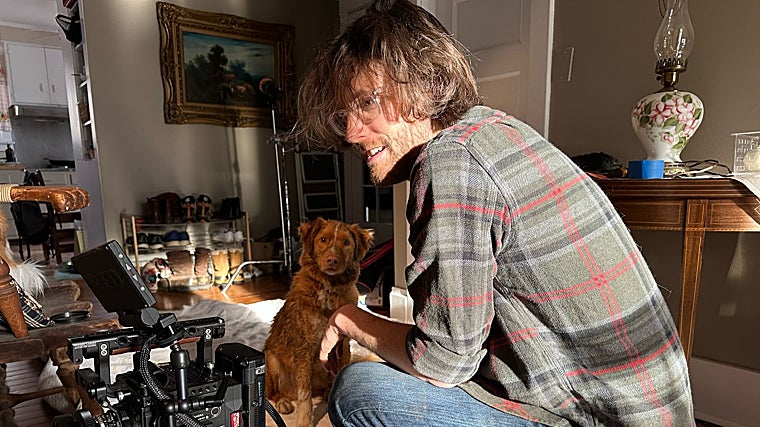
Indy, the protagonist of ‘Good boy’ on the set of the film
That would be the key that runs through the film: although ‘Good Boy’ has elements of horror, its heart is the emotional connection. “You don’t need to exaggerate the drama when you work with a dog”says Leonberg. «The public immediately empathizes with the animals; “They feel with them, sometimes more than with humans.” For the director, the core of the story is unconditional love: “The dog deeply loves his owner and would do anything to save him.” This vision connects with his reflection on why cinema has always revolved around animals: «We see ourselves reflected in them, but Dogs embody a moral purity that humans cannot match. Even the best person has the capacity for evil; Not a dog. If there is a bad dog, it is because someone made it that way.
After passing through festivals such as SXSW, the film has been compared to classics such as ‘The Shining’ and has generated jokes on social networks about a possible Oscar for Indy. “I love reading that, because it means people really believe he’s acting,” he says, smiling. “Achieving that dream was the biggest challenge.” Beyond awards, what moves Leonberg most is the audience’s reaction after each screening: “Most people want to talk about their own dogs. They tell me things they’ve noticed about them, or how the movie made them think about their pet. “It is a universal story about the love, loyalty and vulnerability we share with animals.”


André Itamara Vila Neto é um blogueiro apaixonado por guias de viagem e criador do Road Trips for the Rockstars . Apaixonado por explorar tesouros escondidos e rotas cênicas ao redor do mundo, André compartilha guias de viagem detalhados, dicas e experiências reais para inspirar outros aventureiros a pegar a estrada com confiança. Seja planejando a viagem perfeita ou descobrindo tesouros locais, a missão de André é tornar cada jornada inesquecível.
📧 E-mail: andreitamaravilaneto@gmail.com 🌍 Site: roadtripsfortherockstars.com 📱 Contato WhatsApp: +55 44 99822-5750