


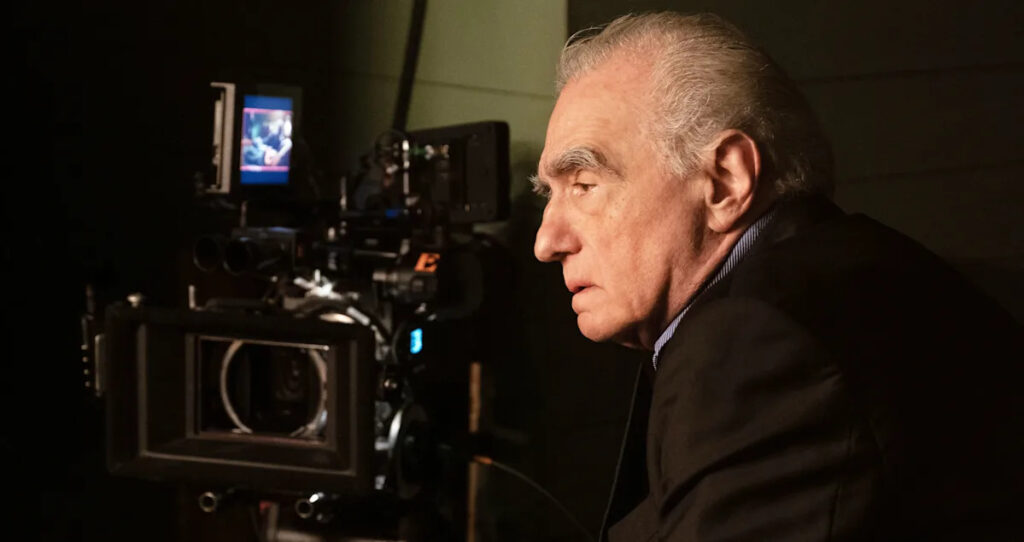
Mr. Scorsesea new five-part documentary, doesn’t just celebrate director Martin Scorsese’s iconic films, such as Taxi Driver (1976), Goodfellas (1990) and The Wolf of Wall Street (2013). Instead, it pulls back the curtain on Scorsese’s upbringing, what influenced his creative decisions and the chaos he went through to get to where he is now.
The nearly five-hour series, directed by Rebecca Miller, is available to stream on Apple TV today and features extensive interviews with Scorsese, 82, his collaborators — including actors Robert De Niro, Leonardo DiCaprio and Jodie Foster — his childhood friends and his family. Together, they chart his journey from an asthmatic kid in Manhattan’s Little Italy to a filmmaker whose vision has helped redefine American cinema.


Leonardo DiCaprio, left, and Martin Scorsese on the set of “The Aviator” (2004). (Apple TV)
Here are five takeaways about Scorsese’s life and career from the series.
Scorsese tried to enter the priesthood, but got kicked out

An undated photo of Scorsese. (Apple TV)
Scorsese initially sought to become a priest because he viewed the church as an escape from the violence he was witnessing in his neighborhood, from mob bosses, local gangs and even his father, who once got in a fight with their landlord. After graduating from Catholic high school in 1960, he joined a seminary on Manhattan’s Upper East Side.
“I did OK for the first few months, but something happened,” he says in the series. “I became aware of life around me — falling in love, being attracted to girls — not that you’re acting out on it, but there are these feelings. And I suddenly realized, it’s much more complicated than this, you can’t shut yourself off.”
Scorsese said he started to feel like he couldn’t devote his life to others — a priest’s fundamental commitment — and became too captivated by the cultural changes happening in the 1960s, like the rise of rock ‘n’ roll.
“I tried to stay, but they got my father in there and they told him, ‘Get him out of here,’” Scorsese says. “I behaved badly.” Scorsese does not offer any more details as to what behavior specifically triggered his expulsion.
A friend’s funeral sparked his path to film school
Scorsese says he thought about studying business at Fordham University — until a moment at the funeral of his friend Louis Frezza, who died from cancer at 18 years old, changed everything.
He says he remembers looking up during Frezza’s funeral in Queens and seeing a giant sign advertising the Continental Can Company.
“That’s what it comes to? You die and they bury you in front of the Continental Can Company,” he says. “I’m not going to work for the Continental Can Company. Who the hell are you? And then, what, bury me right there?”
Seeing the ad at his friend’s funeral guided Scorsese away from business school. He said he found a New York University catalog sometime after the funeral and decided to go to the school’s orientation day. It was there Scorsese first encountered filmmaker Haig Manoogian, who would have an important influence on his career.
Scorsese immediately thought, “That’s where I’m going.”
Hollywood didn’t suit him — but the people changed his life

Steven Spielberg talks about meeting Scorsese in Hollywood in the 1970s. (Apple TV)
Scorsese says he only moved to the West Coast in 1971 after Warner Bros. executive Fred Weintraub told him to.
“Marty was sort of lost in Hollywood,” his childhood friend, Robert Uricola, says. “He was like this stranger in a strange land, and he was trying to make some sense out of it.”
After working on the low-budget film, Boxcar Bertha (1972), Scorsese befriended the film’s producer, Roger Corman (Little Shop of Horrors, The Silence of the Lambs). Corman decided to introduce Scorsese to his other friends, a group of fellow aspiring directors, Steven Spielberg (Jaws, Jurassic Park), Francis Ford Coppola (The Godfather, Apocalypse Now), Brian De Palma (Scarface, Carrie) and George Lucas (the Star Wars franchise); and screenwriters John Milius (Apocalypse Now, Red Dawn) and Paul Schrader (Taxi Driver, Raging Bull).
It was at one party, hosted by De Palma, that Scorsese was introduced to Robert De Niro, then an up-and-coming actor, with whom Scorsese would work on 10 feature films over the next 30 years.
De Niro helped save Scorsese’s life after he overdosed

Left: De Niro in “Taxi Driver” (1976), De Niro in the “Mr. Scorsese” documentary. (Photo illustration: Yahoo News; photos: Courtesy Everett Collection, Apple TV)
Scorsese began using cocaine after the success of Mean Streets (1973) and Alice Doesn’t Live Here Anymore (1974), but it was the failure of New York, New York (1977) that pushed him to use drugs on a daily basis. After his second divorce in 1977, he moved in with his friend, musician Robbie Robertson — kicking off “a period of destructive behavior,” according to Scorsese.
“We were trying to find something. We were trying to find the muse again, I guess,” Scorsese says. “The joke is always, ‘It makes me work better.’ Meantime, you’re dead!”
The filmmaker says he didn’t try to stop or limit his drug use until he collapsed from internal bleeding and nearly died in a New York City emergency room in the late 1970s. It was after he spent 10 days in the hospital that De Niro visited him and asked, “What the hell do you wanna be? You wanna die like this?”
Scorsese says De Niro told him, if he wanted to live, he had to stop doing drugs and work on Raging Bull (1980).
His passion often led to explosive fights with producers


Archival photo of Martin Scorsese (center, in white) on the set of “Gangs of New York” (2002). (Apple TV)
Scorsese had a strong commitment to his artistic vision for his films, which, on occasion, resulted in intense clashes with his collaborators.
When producers told him to adjust scenes in Taxi Driver or the film would receive an X rating, he went crazy, De Palma says.
“I was angry. I said I was going to threaten them, or maybe just shoot or something. I had no idea,” Scorsese says. “What I wanted to do — and not with a gun — I would go in, find out where the rough cut is and break the windows and take it away.”
When he was working with Harvey Weinstein on Gangs of New York (2002), the two argued incessantly, Scorsese says in the final episode.
“I’d been so obsessed with that project for so many years, I put everything into it,” Scorsese says. “The studio, they didn’t want to pay for some of it.”
Scorsese said he got so fed up with Weinstein’s critiques, he went to Weinstein’s office and flipped over a desk. Daniel Day-Lewis, who starred in the film, said he heard Scorsese had actually thrown the desk out of a third-story window.
“Martin’s a cage fighter,” Day-Lewis says. “He’ll be the last one standing.”

André Itamara Vila Neto é um blogueiro apaixonado por guias de viagem e criador do Road Trips for the Rockstars . Apaixonado por explorar tesouros escondidos e rotas cênicas ao redor do mundo, André compartilha guias de viagem detalhados, dicas e experiências reais para inspirar outros aventureiros a pegar a estrada com confiança. Seja planejando a viagem perfeita ou descobrindo tesouros locais, a missão de André é tornar cada jornada inesquecível.
📧 E-mail: andreitamaravilaneto@gmail.com 🌍 Site: roadtripsfortherockstars.com 📱 Contato WhatsApp: +55 44 99822-5750