
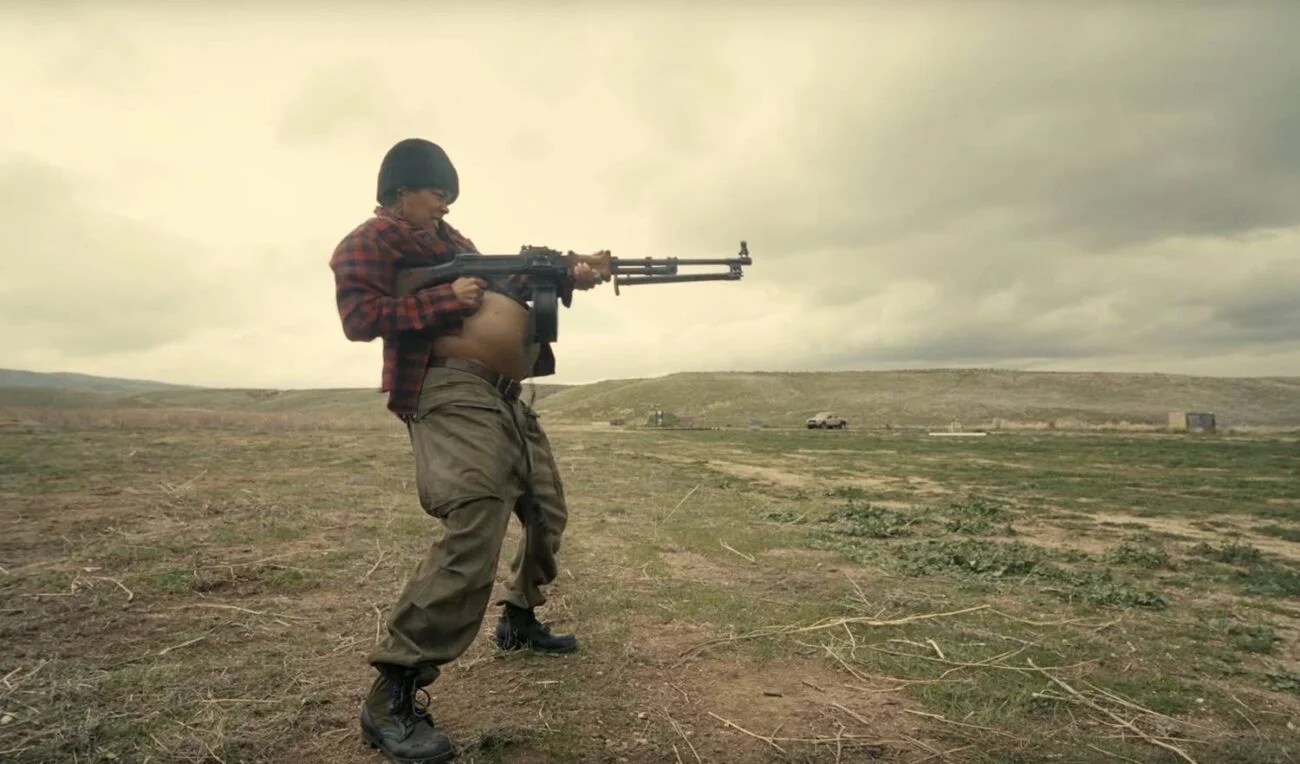
There are movies that try to be grandiose and there are those who are born great. “One battle after another” is a rare case where production size finds the weight of the idea. Paul Thomas Anderson creates a political epic that disguises themselves as an emotional thriller, but what really pulsates under all the dust, shots and chaos is a story about love, failure and redemption. It is cinema in its most visceral form, a scream amid the noise of the modern world.

Leonardo DiCaprio plays Bob Ferguson, a former revolutionary who exchanged the weapons for melancholy. The youth was in the shadows of a past that pursues him, and when his daughter is kidnapped by an enemy he believed buried, the old idealist needs to return to the battlefield. What is designed is not just the search for a daughter, but the reunion of a man with his own ruin. Anderson turns this journey into a spiral of guilt and sacrifice, between memories of lost idealism and the brutality of the present.
Anderson’s camera has something hypnotic. There are plans that seem to breathe along with the characters, creating a tension that grows in silence. With each movement, there is a reminder that the director of “Black Blood” has never lost dominance of the show. It is a film that resembles the viewer of how the cinema can be physical, poetic and political at the same time. The action is not free, humor emerges as bitter irony, and violence serves as a metaphor for a country that insists on repeating its mistakes.
DiCaprio delivers an action that challenges the very myth he built. Forget the impeccable star. Here he is a devastated, dirty man, with the eyes of those who have already lost too much. It is the type of performance that is born of tiredness and explodes in truth. Beside him, Sean Penn emerges as the perfect shadow, an almost biblical presence, oscillating between fanaticism and madness. Teyana Taylor, in turn, carries a magnetic energy, a presence that steals the scene and expands the emotional conflict that supports the narrative.
There is something deeply current in the way Anderson films political idealism and the tiredness of the revolution. Aesthetics is grand, but the look is intimate. Each dialogue looks like an open wound, each scene carries the tension between what has been dreamed of changing and what the world really became. “One battle after another” is a fierce portrait of a country that feeds on its own myths, and a man who discovers that fighting for the truth can also be a way of losing everything.
In the end, the feeling is of exhaustion and ecstasy. It is a movie that does not ask to be loved, but meaning. Paul Thomas Anderson reaches here a level of artistic maturity that dialogues with the tragic and the sublime. Few directors can balance scale and emotion so accurately. “One battle after another” is, first and foremost, a reminder that cinema can still be a battlefield for ideas, emotions and faith.
“One battle after another”
Direction: Paul Thomas Anderson
Screenplay: Paul Thomas Anderson
List: Leonardo DiCaprio, Benicio del Toro, Teyana Taylor
Available in theaters
Stay on top of the news of the largest brands in the world! Access our website Pop brand and find out the trends firsthand.
Related

André Itamara Vila Neto é um blogueiro apaixonado por guias de viagem e criador do Road Trips for the Rockstars . Apaixonado por explorar tesouros escondidos e rotas cênicas ao redor do mundo, André compartilha guias de viagem detalhados, dicas e experiências reais para inspirar outros aventureiros a pegar a estrada com confiança. Seja planejando a viagem perfeita ou descobrindo tesouros locais, a missão de André é tornar cada jornada inesquecível.
📧 E-mail: andreitamaravilaneto@gmail.com 🌍 Site: roadtripsfortherockstars.com 📱 Contato WhatsApp: +55 44 99822-5750