


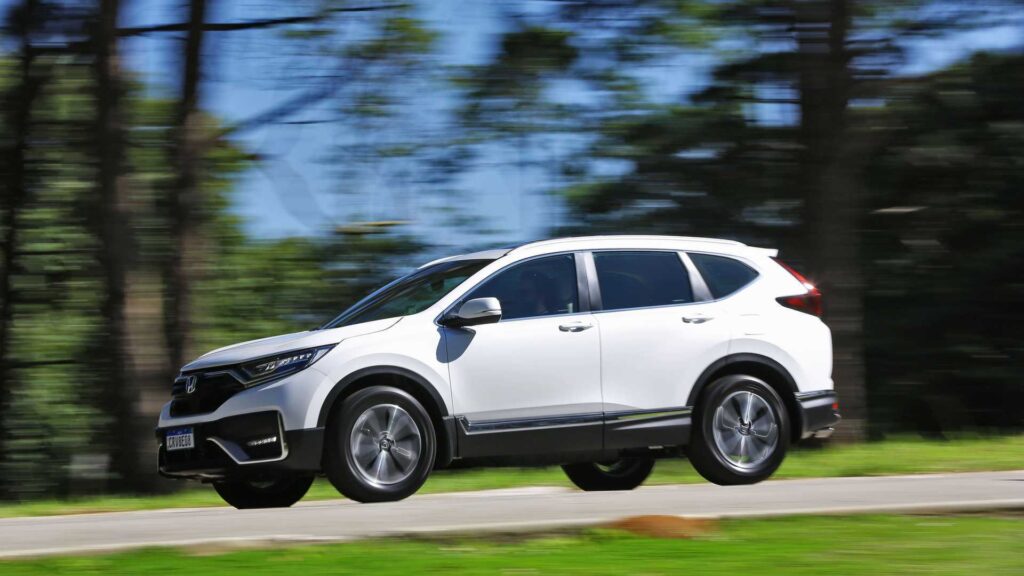
The top of Honda’s car lineup is divided into two very different models: the Accord sedan, now a hybrid, and the CR-V midsize SUV. While the Accord has always sold within expectations in its segment, the CR-V was already a model that sold well, reaching almost 15 thousand units in 2012.
But it ended up losing space with the arrival of smaller SUVs, like the HR-V itself, which met demand within the brand. Furthermore, due to the policies of the then US president, Donald Trump, manufacturers needed to invest more in local production, which forced the withdrawal of SUV production in Mexico and, consequently, the loss of tax exemptions due to the agreement between the Mexican government and Brazil.


8
Now, victim of our devalued currency and paying all possible taxes, the current generation of medium SUV no longer has the protagonism it used to, mainly due to the price. If one day it even came close to the Civic sedan, it was launched in 2018 for R$179,900, which was already R$50,000 more than what was charged for the Civic Touring at that time. Today, restyled and suffering from the devaluation of the Real against the dollar, the Honda CR-V Touring 2021 costs R$264,900 – or more than R$100,000 more than the top-of-the-line sedan.
Therefore, Honda was not in a big hurry to bring the renewed CR-V to Brazil. The car was presented in the USA in September 2019 – yes, two years ago – and visually, as is usual for the Japanese brand, the restyling is very simple, changing the front grille using black paint instead of chrome, new LED fog lights and a redesigned bumper.
The cabin has changed much more, with the adoption of a redesigned storage compartment, with a retractable tray and induction cell phone charger. It kept many of its elements, such as the gear lever at the bottom of the dashboard, just below the air conditioning controls, instead of being on the center console between the seats – something that reminds us of some minivans. One of the points that helps to differentiate it from the Civic is the use of a material that imitates wood on the door panel.
Equipped with a 1.5 turbo four-cylinder engine, fueled only with gasoline, the CR-V moves away from the Civic by offering more power. There are 190 hp at 5,600 rpm and 24.5 kgfm at 2,000 rpm, 17 hp and 2.1 kgfm more than in the average sedan. It maintains the CVT automatic transmission, delivering 7 simulated gears and using an on-demand all-wheel drive system.
It’s not a speedster and that’s not what you expect from a car of this type. We saw this in the measurements, showing 0 to 100 km/h in 8.6 seconds, a good value for a car of its size and weight. As we already saw at the time of the launch of the pre-facelift version, the 1.5 engine gave new life to the vehicle, especially when restarting, which is a little more vigorous – to go from 40 to 100 km/h, 6.6 seconds are needed.
Having the torque at 2,000 rpm already helps to make the CR-V economical and the addition of start-stop made a good difference in urban consumption. If before it was 9.2 km/liter in the city, now we reach an average of 10.8 km/liter, 0.4 km/liter more than the official Inmetro number. Road performance was much better, with 14.3 km/liter, while the label shows 11.9 km/liter.
Like most cars with CVT automatic transmissions, the loud noise is a little annoying under stronger acceleration. Sound insulation helps, but cannot completely eliminate this problem. On the other hand, it is not always that we need to run the engine at a high speed for a long time, precisely because the torque appears early. Furthermore, the CVT kills some of the engine’s excitement, especially when activating Econ mode. We can mitigate this by moving the lever to position S and turning off Econ, but then consumption starts to rise considerably.
The current generation uses an all-wheel drive system that initially uses the front wheels and, depending on demand, sends power to the rear axle. This way, the SUV seems very stable, but don’t expect it to be able to handle some mud, as that’s not the objective. The idea is to maintain balance if you are in a slightly worse condition, such as a wet track with heavy rain – in the United States, where it sells well, it faces seasons of snow.
Driving normally, the CR-V is extremely tame in terms of comfort. The combination of the multilink suspension at the rear, the high-profile 225/60 R18″ tires and the vehicle’s adjustment means that it ignores most irregularities, but without the car feeling soft in curves or making passengers jump if it passes a speed bump at a slightly higher speed. Combine this with the plenty of space in both rows of seats and you can travel peacefully with the family.
As I said before, Honda works with two cars as the most expensive in its line. Now that the Accord has become a hybrid and will focus on electrification, the CR-V ends up relying on other equipment to remain attractive. What’s new for the restyled version is the adoption of the Honda Sensing safety package, adding adaptive cruise control, lane keeping assistant, autonomous emergency braking with alert and others.
The cruise control works as expected when working with the lane assistant, detecting the lines well to keep the vehicle on the lane, even capable of making some curves, but always requiring the driver to keep his hands on the steering wheel. A small criticism is the forward collision warning, which is a bit desperate and which beeps in cases even when the driver is already braking and there is a good distance ahead – at least it doesn’t make a whistle like in some rivals.
It received a wireless charger for smartphones, which led to a change in the position of the USB port and the end of one of the storage compartments. The multimedia center remains the same 7″ and is compatible with Android Auto and Apple CarPlay, but requires the use of a cable. Rounding off the new features are the panoramic sunroof, the audio system with subwoofer and the aforementioned start-stop.
It doesn’t seem like much, but the car was already well equipped, with some items that are still difficult to see in the segment, such as the head-up display (with a piece of acrylic instead of projecting information onto the windshield) or Lane Watch, which uses the camera on the passenger side to transmit an image to the multimedia center every time we activate the right turn signal. It also has a rear camera, front and rear parking sensors, rain and light sensors, electronic parking brake and others.
The instrument panel uses a 7″ screen in the center which is very useful, showing all the information there and in a good view. The weak point is that it still requires the driver to press the small “stick” that pops out of the panel to reset the mileage and average consumption, something that has not been done for some time even in some cheaper cars.
If it were cheaper, recommending the Honda CR-V would be very easy, even in the face of direct competition. The SUV has a different feel to some models in the segment, due to its more refined finish, space and comfort, but it is difficult to say that it is worth paying R$264,990 when there are cheaper options in the category – a Peugeot 3008, with a very similar list of equipment, costs R$249,990 while the Volkswagen Tiguan R-Line costs R$236,090 (although this will change soon).
Its main rival, the Toyota RAV4, costs R$284,490, but at least it has the argument of having a hybrid system. Honda could have invested a little more and brought the CR-V Hybrid, remembering that the brand promised to launch three hybrids in the country and, so far, only the Accord has appeared here. Who knows, when it switches to the electrified model, it will become more interesting for a car of this price.
Photos: Mario Villaescusa (for or Motor1.com)
Honda CR-V Touring 2021
Motor
front, transverse, 4 cylinders, 16 valves, 1,498 cm³, double variable valve timing, turbo, direct injection, gasoline
Power and torque
190 hp at 5,600; 24.5 kgfm from 2,000 to 5,000 rpm
Transmission
CVT automatic transmission with 7-speed simulation; automatic all-wheel drive
Suspension
McPherson strut at the front and multilink at the rear; 18″ wheels with 235/60 R18 tires
Weight
1,629 kg in running order
Length and wheelbase
4.904 mm; 2.660 mm
Width
1.855 mm
Height
1.689 mm
Capabilities
trunk: 522 liters; tank: 57 liters
Entry price
R$ 264.900
Acceleration
0 and 60 km/h: 4.2 s; 0 and 80 km/h: 6.1 s; 0 and 100 km/h: 8.6 s
Resumption
40 to 100 km/h (em D): 6.6 s; 80 to 120 km/h (em D): 6.0 s
Braking
100 km/ha 0: 40.1 m; 80 km/and 0: 25.4 m; 60 km/and 0: 14.3 m
Fuel consumption
city: 10.8 km/l; highway: 14.3 km/l


André Itamara Vila Neto é um blogueiro apaixonado por guias de viagem e criador do Road Trips for the Rockstars . Apaixonado por explorar tesouros escondidos e rotas cênicas ao redor do mundo, André compartilha guias de viagem detalhados, dicas e experiências reais para inspirar outros aventureiros a pegar a estrada com confiança. Seja planejando a viagem perfeita ou descobrindo tesouros locais, a missão de André é tornar cada jornada inesquecível.
📧 E-mail: andreitamaravilaneto@gmail.com 🌍 Site: roadtripsfortherockstars.com 📱 Contato WhatsApp: +55 44 99822-5750