
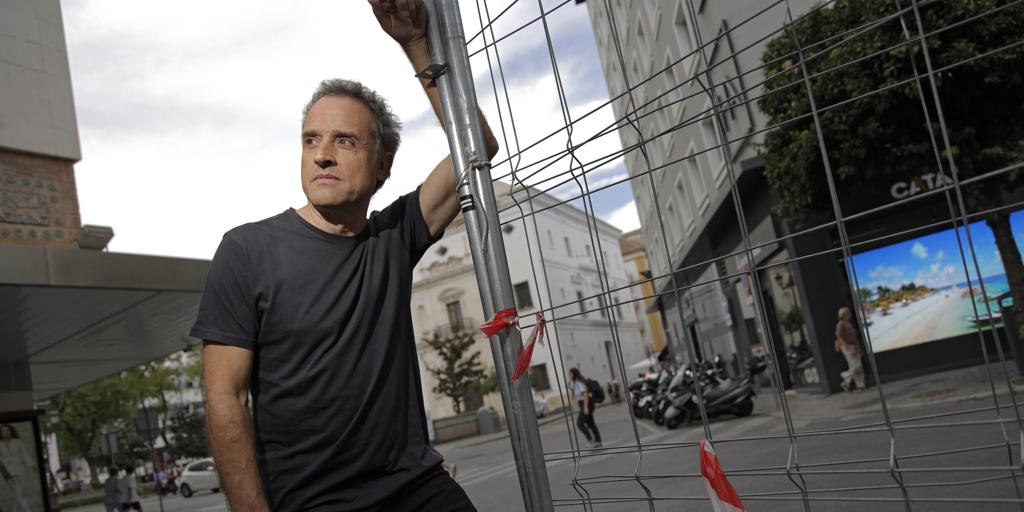
Daniel Guzmán’s (Madrid, 52 years old) voice cracks because he speaks with real emotion about ‘The Debt’, the film that opens in theaters this Friday after four years of work and a five million budget. A wild and personal adventure – like all his … projects – in which he has once again left, in addition to his voice, almost his life. Because Daniel Guzmán writes (based on a personal story in which his grandmother was very present), directs, stars and produces this story in which a hustler ends up lost in a labyrinth from which it is impossible to get out. At the exit, however, Charo awaits him, an elderly woman over 90 years old whom he takes care of and who surprises on screen with a sly humor and a naturalness unbecoming of someone making his screen debut. She is the light in a story where the social drama of the gentrification of the center of Madrid is mixed with the thriller of gangsters in the suburbs. A real “mess” of production with explosions, chases… And a heartfelt tribute to grandmothers.
–’The debt’ talks about debts as a society with older people, also about the debt that the protagonist ends up assuming with bad guys, whether they are gangsters or banks…
And there is also the producer’s debt. It has really been complicated, because we have been in that flight forward, because the ball is exactly the same one that is going to pass over our protagonist Lucas, who is always – as he is in search and capture – looking back to see if the police catch him or to see if that ball is going to crush him. I had that same flight forward as a producer along with my partners: to finish the film, so that it could be released… Because it is an extremely risky film. It is my most ambitious film on a narrative level, because it combines a social premise with a thriller. Then, at a budgetary level, it is a 5 million euro film – the average films are between 2 and 3 million at most – with 78 locations – three times more than a conventional film – and we have shot it in 10 weeks – the average is five or six. In the end, everything is exponential and in the end it becomes a ball that is impossible to control. I often see myself as on that train that goes at 300 without brakes but from which you can’t get off.
–Writes the script, directs, produces, is the protagonist. How does Daniel Guzmán get along with all those ‘danieles guzmanes’ in the middle of such a complex adventure?
–He doesn’t get along well, really. The equation always comes out negative and, generally, in my case the author usually wins, but the producer loses. It is true that this allows me authorial freedom and to make the films that I feel and that I want to make, and that if other people produced them I would have to sacrifice my way of telling my stories. I would very much like to be able to continue directing what I write, but I prefer not to act in my films.
–Why did you do it in this case?
–Due to force majeure, I could not do it any other way. When I finished the three months of rehearsals with Charo, I began the search for the lead actor and, when I was almost there, Charo suffered a fall in the nursing home and the therapists and his children told us that either we would shoot at that moment, or most likely he would not be able to shoot. I found myself at that dead end, because in two weeks I was not going to be able to prepare my partner. As the story started from a personal experience, the people who were in the project – such as the directors of Televisión Española, of Movistar, who had seen the three months of work I had done with Charo in the tests – told me that I had to do it. In the end, I made that decision, but it’s better to just direct and write. And most importantly: never, if you love someone for whom you prefer things not to go well, encourage them to produce and direct; but if you have a friend who is thinking about directing and producing, get him out of your head.
–What is Daniel Guzmán for Spanish cinema?
–Well… no, I don’t really know. Well, no one, I don’t know… someone who tells stories, who gets involved and who bets everything on that story to unsuspected limits. He is someone who is attached to the truth, to life, and the stories he tells are born from life and I hope that the audience is entertained, moved and invites them to reflect. Cinema has given me everything, it has given me meaning to my life, and in that way I cannot conceive it any other way than giving everything to cinema by making personal films that not only entertain, but that accompany you for a while.
–If I define him as someone who has given up much more to make auteur films than others who fill their mouths with ‘authorship’, is that definition close to reality?
–If you say it, I respect it… and it is close to reality. It makes me ashamed to hear it, but at least I try: I try to make the cinema or the stories I tell be about the people who walk down the street, about the people who try to get ahead, the people who have enthusiasm, hope and a sense of humor. You have to laugh at yourself and at everything around you and I respect the audience a lot because I like films that respect me and that treat me intelligently. I believe that the public is intelligent, I try to be attached to reality and make films without impostures, without conventions.
-You got off a train of fame and money like ‘No one lives here’ to try to make your own films… How much have you had to give up to make the films you wanted?
–To many things, I don’t know if too many, but many and not only on a professional level but on a personal level. When you look back and see that in 20 years you have made 3 films, you know that you have given up a lot of things. I am lucky – and I prefer not to get emotional because it is true that this is something I cling to – that I am lucky to have great friends, a great family and people around me who love me and who encourage me to continue, even though I often lose things along the way. Because they know that it is my life and that it takes up a lot of my time being with them, but hey, we love each other so much that they continue to support me even if I don’t see them. That on a personal level… On a professional level, well obviously I stopped working as an actor at a time when I was doing very well, the best time in terms of fame and economic level. There I made the decision to leave everything to tell a story that was ‘In exchange for nothing’. I thought it was going to take me 1 or 2 years and it took me 10. I didn’t know it was going to be so difficult to tell personal stories. For my second film, ‘Canallas’, it took me 6 years, and for this one, ‘The Debt’, four. In the end, you leave everything, but I felt that I had to do it and, although it is very hard, it is what I want to do. Nobody forces me, I am free, I continue to maintain my authorial freedom and, when I have a need to tell a story, I do not stop until I achieve that goal.
–In ‘In exchange for nothing’ (2015) he approached Aluche, his neighborhood, in ‘The debt’ (2025) he filmed a lot in Plaza de España and the center. What has changed in Madrid in this time, just a decade?
–Increasingly the center has grown more due to gentrification and people have been removed from their homes to turn it into tourist apartments. The model of large cities is a city model where it bets everything on tourism and where it tries to obtain the greatest possible benefit from an asset such as housing, for its exploitation. And we have already reached limits or a tension that can only be solved with government measures, because it is true that capitalism ends up devouring itself and, if there are no structural social measures through governments, then this is the jungle and the law of the fittest, and the fittest generally has to do with banking, real estate companies and investment funds.
–And what remains of Typhon, that graffiti boy from Aluche who ended up as a filmmaker?
-Lot. The illusion remains, the desire to tell stories remains. Before I did it through graffiti and now I do it through movies; I have done it for many years as an actor through my characters. Perhaps that rebellion remains, that need for freedom; also that need to express oneself through stories and, the truth is that there is also that nostalgic smile when I see it and, especially now, more and more, to give the necessary importance to each thing. I think I haven’t changed in that: I’m still restless and I still have that Peter Pan there which is an engine to basically tell stories.
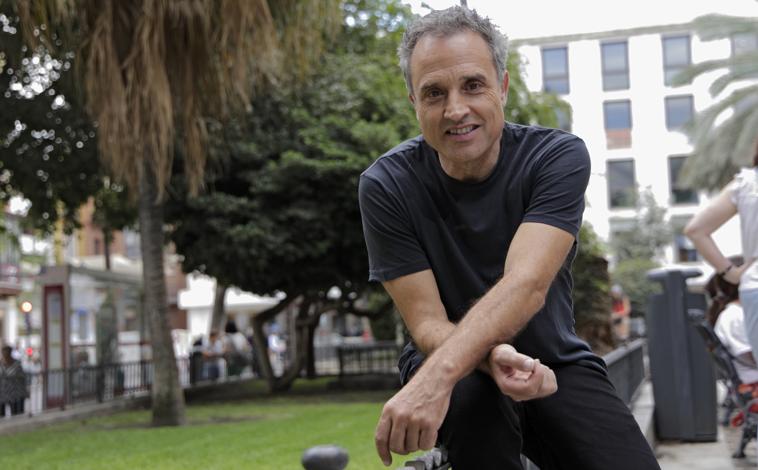
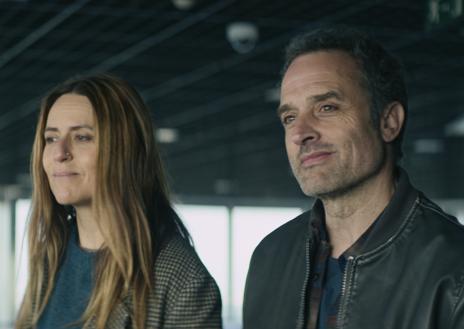
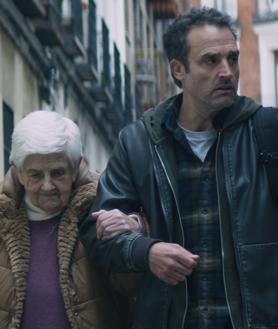
The adventure of discovering a nonagenarian revelation actress
«We are looking for Charo like a needle in a haystack. We saw over 700 older women. I started on the streets for months, in markets, in day centers, in health centers, in residences; I was looking for her everywhere and, after almost six months of searching, I found her. I needed him to meet several personal conditions because the character is based on my grandmother, because the trigger from which the story arises is something that I had experienced with my grandmother. It is a personal issue that we live in a health center and, from there, I generated the story. I needed to find in Charo fragility, vulnerability, sense of humor, innocence, humanity, common sense; I mean, there are a lot of characteristics to find, because I needed that character to convey that and, until I found everything, I didn’t stop,” explains Daniel Guzmán.
«I entered the residences together with my casting director and the residents when they saw me said, look, the boy from ‘No one lives here.’ He told them that he was going to make a movie and that he was looking for a 90-year-old person to star in it and it threw them off. After 10 or 20 minutes of talking to them, everyone already wanted to participate, because it is a wonderful experience for someone so old who is in the last stage of their life, because it makes them feel useful, it makes them see that they are not excluded. They were all very excited, playing a lot in the tests, having a lot of fun; In a certain way, it changes their routine, it changes their lives and gives them meaning and hope, the truth is,” he concludes.
André Itamara Vila Neto é um blogueiro apaixonado por guias de viagem e criador do Road Trips for the Rockstars . Apaixonado por explorar tesouros escondidos e rotas cênicas ao redor do mundo, André compartilha guias de viagem detalhados, dicas e experiências reais para inspirar outros aventureiros a pegar a estrada com confiança. Seja planejando a viagem perfeita ou descobrindo tesouros locais, a missão de André é tornar cada jornada inesquecível.
📧 E-mail: andreitamaravilaneto@gmail.com 🌍 Site: roadtripsfortherockstars.com 📱 Contato WhatsApp: +55 44 99822-5750