
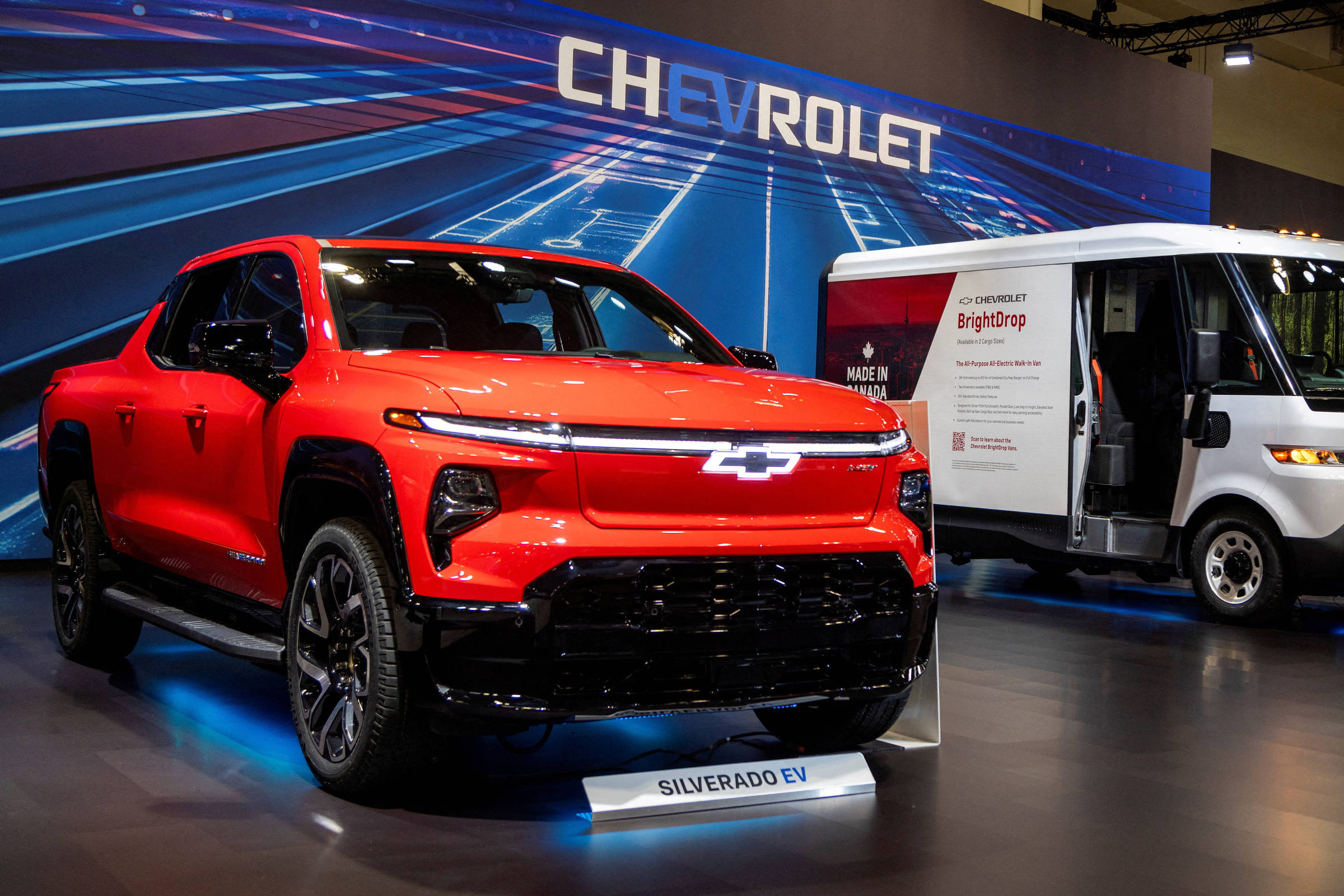
The Chevrolet Silverado has been one of the most popular pickup trucks in the United States since it was introduced nearly three decades ago. But the iconic vehicle could now become one of the biggest casualties of Donald Trump’s trade war.
General Motors’ high-margin model, which costs approximately between $40,000 and $70,000, relies on one of the most complex, international and interconnected automotive supply chains, making it particularly vulnerable to the US president’s threat to impose 25% tariffs on Canada and Mexico.
Of the 673,000 Silverados produced last year, 31% were built at GM’s plant in the Mexican city of Silao and 20% at its plant in Oshawa, Canada.
But even for the roughly other half manufactured at three U.S. plants in Michigan and Indiana, it’s likely that the power steering and door trim panels were manufactured in Mexico; rear lighting in Canada; the airbag module in Germany; and the central display in Japan, according to data from S&P Global Mobility.
GM has been preparing for tariffs since Trump’s election, Chief Financial Officer Paul Jacobson said at an investor conference last month.
The automaker has shifted some production and reduced inventory at factories outside the U.S. by nearly a third “because the last thing you want is a bunch of finished inventory that’s suddenly 25% more expensive just with the passage of time.”
If the tariffs become permanent, he said, the company would need to consider whether to relocate factories. But with the current uncertainty, GM can’t spend billions “swinging the business back and forth.”
Data compiled by Export Genius shows that key components in Silverados rely heavily on parts imported from Mexico. The country’s vehicle parts exports were worth almost US$30 billion (around R$175 billion) last year, with brake systems alone representing US$4.3 billion (R$25 billion).
Trump threatened tariffs on Mexico and Canada in early February, then announced a 30-day suspension hours before they took effect — but promised on Thursday (27) to move forward starting March 4. The unrest will be worse if tariffs expand to goods imported from the EU and the rest of the world.
The big fear within the industry is that Trump will impose sweeping tariffs without mechanisms that are usually in place to mitigate their impact, such as tax refund programs through which tariffs can eventually be refunded if imported goods are later re-exported.
“This is not a trade action. This is a border security negotiation,” said Dan Hearsch, Americas leader in the automotive and industrial practice at consultancy AlixPartners, referring to Trump’s argument that he was imposing tariffs in response to the flow of illegal immigrants and drugs across the Mexican and Canadian borders.
Mike Wall, executive director of automotive analysis at S&P Global Mobility, said companies were doing a “deep dive” into the supply chain to identify bottlenecks. “If they can and where they can, they will try to shift some of that supply,” he added.
But a shift in manufacturing from Mexico to the U.S. would take time and be expensive, while higher labor prices would increase production costs.
Ford CEO Jim Farley warned that “billions of dollars in industry profits” could be wiped out if there were prolonged tariffs on imports from Mexico and Canada.
John Elkann, president of Stellantis, which owns Chrysler, this week called on Trump to keep products from Mexico and Canada tariff-free. Instead, he urged the U.S. to close what he described as a “loophole that currently allows approximately 4 million vehicles to enter the country” without requiring U.S. content, as is the case for cars made in Japan and South Korea.
Willebaldo Gómez Zuppa, an economics professor at the National Autonomous University of Mexico and a researcher at the country’s Center for Labor Research and Union Consultancy, said the tariffs would increase the price of vehicles like the Silverado, hurting demand — and could even exacerbate the immigration problem.
Highly paid workers at the GM plant in Silao earned $5.50 (about R$32) an hour, Gómez Zuppa said. But the company cited the threat of tariffs last month when it rejected a proposal from the labor union at the plant to raise wages.
The tariffs “will change the course of integration that the three countries have followed since 1994,” he said.
GM, Ford and Stellantis operate their Mexican factories in regions from which there has already been significant migration, he added.
“In the event that these companies close and relocate, it will impact the entire regional job market, and therefore we anticipate that migration from this region will increase,” he said.
Kana Inagaki, Paul Caruana Galizia, Ian Bott, Bob Haslett, Chris Cook and Claire Bushey

André Itamara Vila Neto é um blogueiro apaixonado por guias de viagem e criador do Road Trips for the Rockstars . Apaixonado por explorar tesouros escondidos e rotas cênicas ao redor do mundo, André compartilha guias de viagem detalhados, dicas e experiências reais para inspirar outros aventureiros a pegar a estrada com confiança. Seja planejando a viagem perfeita ou descobrindo tesouros locais, a missão de André é tornar cada jornada inesquecível.
📧 E-mail: andreitamaravilaneto@gmail.com 🌍 Site: roadtripsfortherockstars.com 📱 Contato WhatsApp: +55 44 99822-5750