
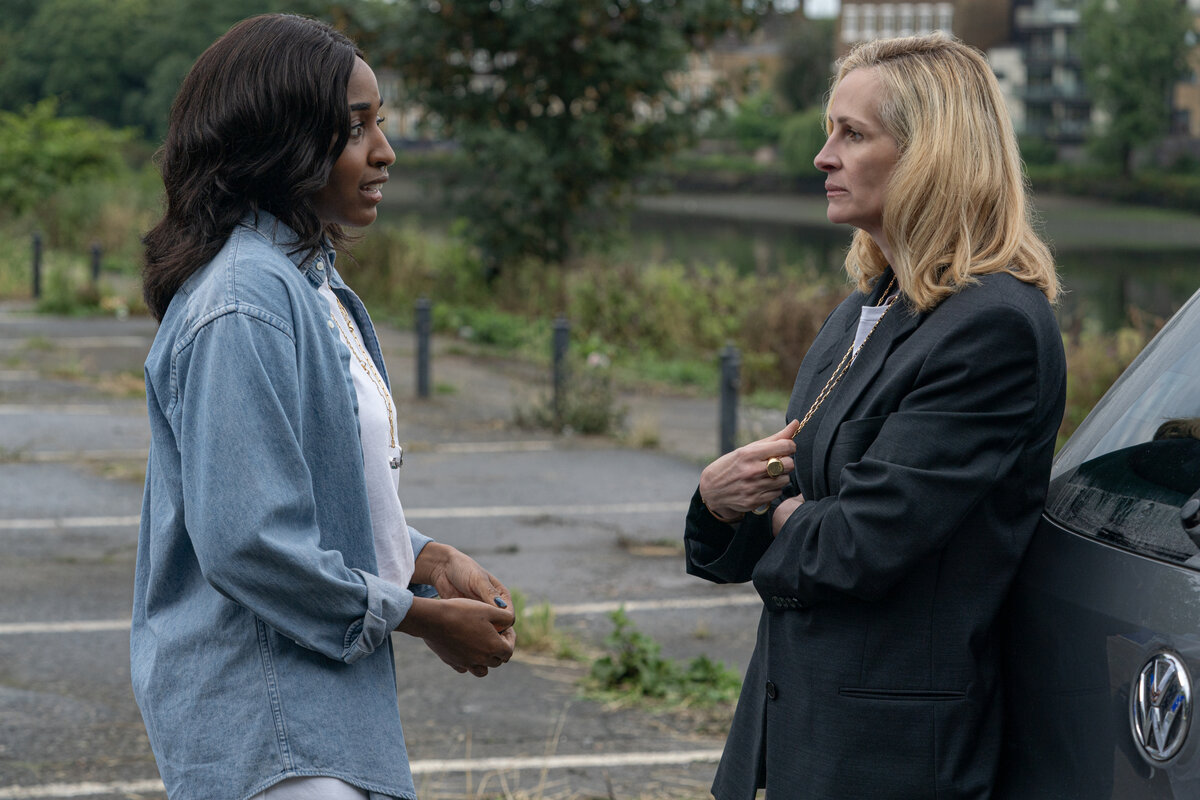
Till now, tireless parley has actually had no place in Luca Guadagnino’s lavish cinema. It is perhaps due to the setting that the spoken word now takes up so much space for the first time: “After the Hunt” is set at Yale University and follows the entanglements of characters who teach and study at the philosophy faculty both on and off campus.
Intellectual debate is part of the job description of the lecturer friends Alma (Julia Roberts) and Hank (Andrew Garfield). Both are committed to the goal of obtaining a highly competitive permanent position. And the opening suggests that this obviously requires not only special intellectual brilliance, but above all the public display of it.
Whether the “right” worldview or even identity is also needed is also provocatively discussed. At a small soirée in an exclusive circle to which Alma has invited, questions of ethics in the broader sense and political correctness in the narrower sense are discussed. For example, whether thinkers like Hegel, Nietzsche and Freud should be re-read (or not read at all) because of their “problematic” biographies or statements.
What Luca Guadagnino always returns to is the desire and hunger for human connection
Both Alma and Hank disagree and are still popular with their students. They bask in their admiration – and seem to have it for each other too. But Alma’s greatest admirer is her doctoral student Maggie (Ayo Edebiri), who immediately throws herself into a verbal duel to save her honor.
A fellow student claims that if it comes to a decision between Hank and Alma when awarding the job, she will of course get the job – because she is a woman and the white, heterosexual cis man will now be systematically disadvantaged in the same way that he was previously favored. Maggie counters that you might be able to use its power discourse question, she in the Praxis but is unbroken.
Charged keywords
This means that the social trenches have been drawn: at least superficially, “After the Hunt” revolves around charged buzzwords such as “cancel culture” and “identity politics”, around “diversity” debates and “wokeness”. But playing with the facade, with the question of what is being discussed on the surface and what it is actually about, has become the director’s new signature since “Challengers” – a mirage of a sports drama.
What Luca Guadagnino always returns to, albeit in a constantly new guise, is the desire and hunger for interpersonal connection – of characters who are so driven by an inner longing that they can’t help but follow it.
We would like to show you external content here. You decide whether you also want to see this element:
How great the director’s sympathies are for this commitment to desire is shown not least in the iconophilic compositions in which he dresses his characters and gives them a visual tenderness even in moments of morally ambivalent action. In “After the Hunt” such tenderness is missing, simply because there is no such commitment here. Only Alma’s husband (Michael Stuhlbarg), a psychoanalyst, acts as a melancholic truth-teller, as an “authentic relief,” so to speak, in a plot network that otherwise only knows repression.
Alma, Hank and Maggie are primarily concerned with their own professional advancement and with the even more mundane desire to look good. “After the Hunt”, written by Nora Garrett, puts this to the test on an explosive case: After the evening in question, Maggie turns to Alma and tells her about a sexual assault by Hank. Alma does confront him – he denies it and counters with accusations of plagiarism against Maggie’s dissertation, which she is now trying to cover up. But Alma is far more concerned about the possible consequences for herself than about clarification.
Class versus identity
The film itself remains vague about what actually happened. However, what is already implied at the beginning becomes more discursive: Hank refers to his “class” to Alma. He will not allow his advancement to be thwarted by a self-righteous scion from a wealthy family.
Because Alma doesn’t follow her descriptions without question, Maggie in turn publicly denounces her doctoral supervisor as just another white woman who is abandoning a black, queer woman at the crucial moment. The film does not take a clear position in the conflict between “class” versus “identity”, but rather shows the social distortions that arise when such arguments are not used out of conviction of their correctness, but as a strategic weapon.
„After the Hunt“. Director: Luca Guadagnino. Mit Julia Roberts, Ayo Edebiri u. a. USA/Italian 2025, 139 Min.
In this respect, “After the Hunt” ultimately proves to be a film by Luca Guadagnino: at its core, it is about a reckoning with hypocrisy itself, embodied by characters who are only interested in their reputation and flee from the inner truths that are otherwise so important in his work.
Above all, “After the Hunt” cleverly addresses social tensions and provokes exciting discussions. Precisely because the film doesn’t want to be pleasing, but has the courage to dare to create ambiguities that some viewers will find exhausting. But, as it says in the film itself: “Not everything is meant to make you feel comfortable.”

André Itamara Vila Neto é um blogueiro apaixonado por guias de viagem e criador do Road Trips for the Rockstars . Apaixonado por explorar tesouros escondidos e rotas cênicas ao redor do mundo, André compartilha guias de viagem detalhados, dicas e experiências reais para inspirar outros aventureiros a pegar a estrada com confiança. Seja planejando a viagem perfeita ou descobrindo tesouros locais, a missão de André é tornar cada jornada inesquecível.
📧 E-mail: andreitamaravilaneto@gmail.com 🌍 Site: roadtripsfortherockstars.com 📱 Contato WhatsApp: +55 44 99822-5750