


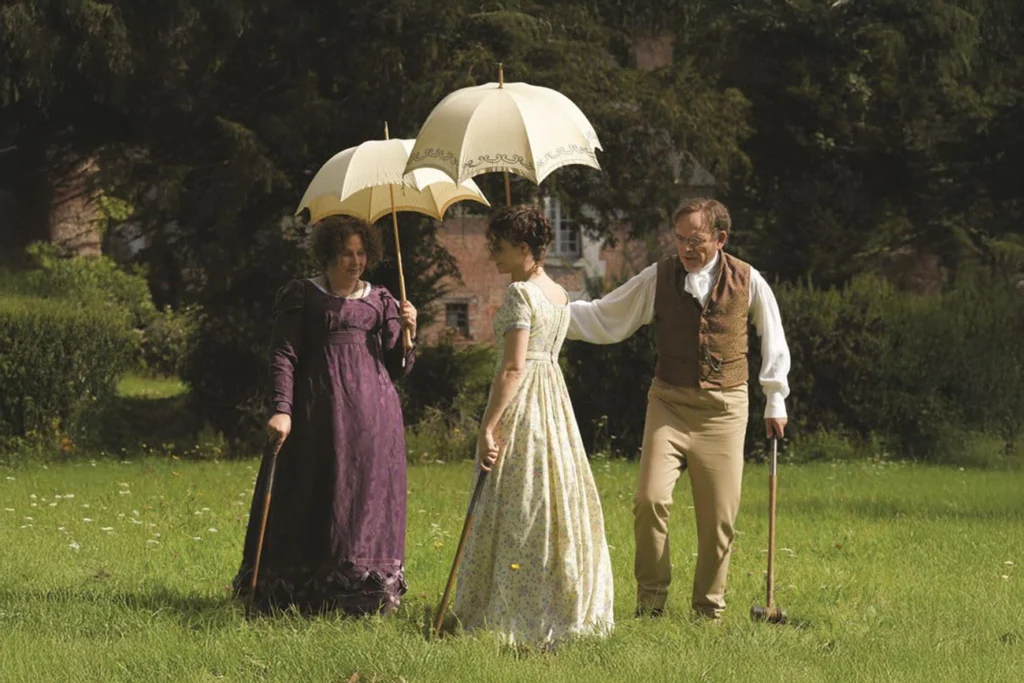
The central proposal is to observe how an education focused on domestic harmony can become a gateway to a life defined by contracts and other people’s expectations. In “The Life of a Woman”, based on the novel by Guy de Maupassant, with Judith Chemla, Swann Arlaud, Jean-Pierre Darroussin and Yolande Moreau, directed by Stéphane Brizé, this transition between youthful dream and monitored routine is imposed through discreet formal choices and restrained performances. From there, the film traces a learning trajectory marked by temporal cuts that make time work as a dramatic force, always linked to the consequences of decisions seen, at first glance, as small.
Marriage appears from an early age as a terrain where affection and asset management go hand in hand, and the protagonist learns to read signs that previously seemed like mere etiquette. Letters sent late, advice from religious and trusted men, recommendations about dowries and properties: nothing sounds casual, because each gesture carries material and symbolic implications. Instead of looking for big revelations, the narrative is interested in changes in tone in the conversation, in hesitations at the table, in a look that doesn’t hold when the topic of money comes up. The accumulation of these clues shows how cordiality can serve as a cover for persistent hierarchies.
The photography prefers natural light and moderate tones, avoiding easy glare to reinforce that the beauty of the landscape does not neutralize social surveillance. Gardens and beaches, in theory places of freedom, function as extensions of a world that watches and comments. Inside the house, doors and corridors remind us that intimacy coexists with rules of circulation and privacy that belong more to the clan than to the individual. The sound avoids underlining, and conflicts are resolved in undertones, which is consistent with a society that values appearance and reputation. Therefore, when there is a gesture of true welcome, the impact is measured by the contrast with the routine of formalities.
Judith Chemla embodies a woman who needs to reconcile tenderness and prudence, and this combination appears in her care with her words and her posture in the face of impositions that arrive disguised as common sense. Swann Arlaud plays a husband who is respected in public, but fragile when faced with responsibilities that he cannot admit. Jean-Pierre Darroussin and Yolande Moreau represent parents divided between protection and attachment to uses that guarantee stability to the family name itself. The set avoids caricatures, because the deviations do not depend on an isolated villain; they arise from habits and incentives that reward a specific type of male behavior and demand that women maintain order.
The relationship between mother and son reveals how the discourse of unconditional love can turn into complacency when society prepares the heir to be forgiven in advance. Lacks are not limited to morality, but to expenses that accumulate and promises that ask for new advances. The protagonist tries to balance affection and firmness, but finds little help in an environment that urges her to understand and endure. Each concession reflects a diffuse pedagogy, taught without fanfare, that legitimizes indulgence and transfers the bill to those with less room for maneuver. This process does not produce spectacular explosions; it manifests itself in delays, discreet humiliations and permanent expectations that everything will be fixed.
The option for ellipses adds density to the route. Brizé prefers to jump back in time and return when life has already settled down, asking the public to identify changes in the climate of relationships. This strategy values patience and reinforces that nothing can be decided in a single meeting. The consequences appear gradually, and the portrait of a hopeful youth gives way to an adult attentive to the cost of each gesture. The film, thus, brings the past closer to the present without needing to announce current affairs: the rules of guardianship, the network of conveniences and the use of marriage as an economic tool remain recognizable, just by changing vocabulary and scenery.
When dealing with the nineteenth-century novel, the adaptation runs the risk of appearing fatalistic; overcome it by focusing on possible choices, even if narrow. The protagonist is not an example of idealized purity or caricatured naivety. He makes mistakes, takes time to realize, tries to convince himself that conciliation will avoid greater losses. This ambivalence gives verisimilitude to the itinerary and makes maturing a daily task, closer to a short step than a big turning point. When some gesture of generosity resists, it does not erase all the pain, but it indicates that dignity and memory can coexist with disenchantment without converting into cynicism.
The management trusts the interpreters and removes adornments that would distract from the essential. The camera remains close enough to record the effort to maintain composure when the conversation threatens to damage the public image. The editing refuses didactic explanations, but does not lose the clarity of the sequence. Environments, even the most beautiful ones, preserve signs of order and control that weigh on those who do not define the rules. The soundtrack, used sparingly, lets words and silence support the weight of decisions. Each resource remains at the service of the same idea: private life is also a political field, because intimate choices respond to contexts that go beyond individual will.
The film’s interest is less in the falling of masks than in the difficulty of sustaining convictions when reality demands renunciation. The protagonist learns to select affections that do not push her towards dependence and preserves bonds that do not require humiliation as a bargaining chip. There are clear losses and there are discreet gains, such as the possibility of moving forward while maintaining a notion of justice that does not confuse forgiveness with submission. The ending avoids promises of automatic repair; offers the image of a woman who understood the extent of her limits and found, within them, space to continue living.
Without resorting to easy formulas, the group reaffirms that time, when well observed, reveals what occasional speeches prefer to hide: hereditary privileges, postponed responsibilities and the emotional bill paid by those who were educated to maintain a balance that benefits others. The interest in recording this learning makes “The Life of a Woman” a study of character and context, in which romance, family and money intertwine and produce palpable effects on destiny and memory. The permanence of these themes, read today, indicates that the story told there remains relevant as long as there are relationships shaped by convenience and appearance that demand silence.
Film:
A Woman’s Life
Director:
Stéphane Brizé
Again:
2016
Gender:
Drama
Assessment:
8/10
1
1
Marcelo Costa
★★★★★★★★★★


André Itamara Vila Neto é um blogueiro apaixonado por guias de viagem e criador do Road Trips for the Rockstars . Apaixonado por explorar tesouros escondidos e rotas cênicas ao redor do mundo, André compartilha guias de viagem detalhados, dicas e experiências reais para inspirar outros aventureiros a pegar a estrada com confiança. Seja planejando a viagem perfeita ou descobrindo tesouros locais, a missão de André é tornar cada jornada inesquecível.
📧 E-mail: andreitamaravilaneto@gmail.com 🌍 Site: roadtripsfortherockstars.com 📱 Contato WhatsApp: +55 44 99822-5750