
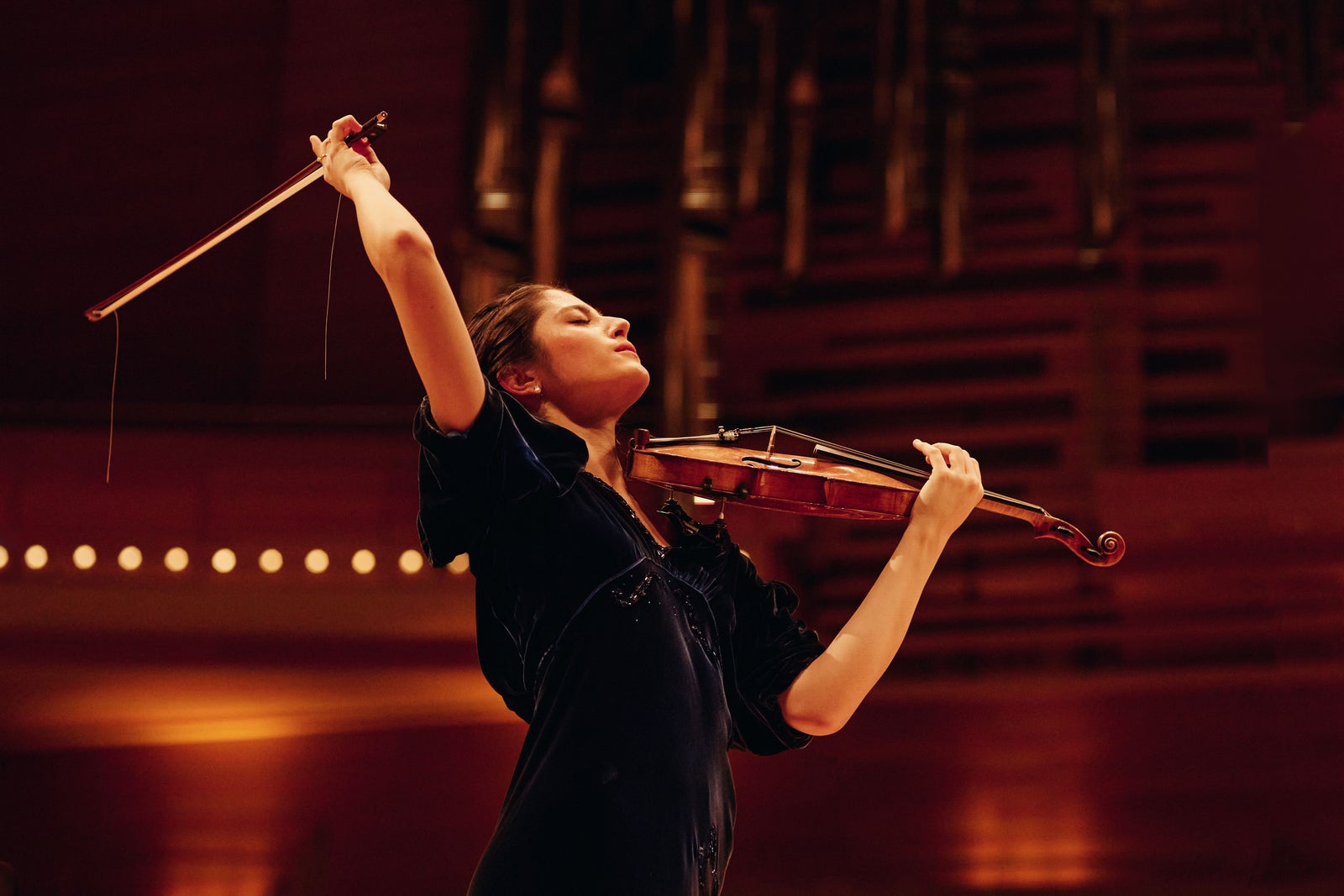
Audrey Benac (Deragh Campbell), doctoral student in musicology, devotes her thesis to Kathleen Parlow (1890-1963), a Canadian violin prodigy who experienced early brilliance before fading into obscurity. At the bedside of a failed violinist mother whom she is about to lose, Audrey follows the trail of a concerto dedicated to Parlow — theOpus 28 — and crosses Toronto, London and Oslo to exhume letters, recordings and scores. Her quest aims as much to make the musician audible again as to tame a cumbersome maternal heritage, by embracing the reverberations of a disappeared work which seems to speak from the other shore.
Archives, mirrors and ghosts
Sofia Bohdanowicz creates a palimpsest where fiction and documents intertwine: pages of manuscripts framed like still lifes, listening sessions on old media, voiceovers, which give substance to Parlow’s correspondence. Audrey’s obsession clings to a very real historical thread: the Violin Concerto in C major, Op. 28by Johan Halvorsen, dedicated to Parlow and rediscovered in 2015 in the archives of the University of Toronto, after having long been considered lost. The film makes this a dramatic key and a gesture of reparation — the old music found resonating in the present.
Bohdanowicz also recalls the Norwegian roots of the violinist, to whom a patron offered a Guarneri del Gesù that had belonged to Viotti: a biographical detail that the staging converts into a motif of circulation between countries, patronage and transmission.
Stylization: annoyance and magnet
The first sequence is deliberately abrasive: the stridency of the violin, the spinning camera, the oversaturation of the voices – in short, enough to keep you at bay. Then the form calms down and settles: fixed planes, geometric compositions, rhythms of patterns. Bohdanowicz approaches the cinematographic essay and assumes a film of ideas, cerebral, which could only excite academics – and yet, its extremely stylized, symbolic staging, grabs us. Because the gesture is not demonstrative: it proceeds through reverberations, melodic returns, symbols (fire, blood, musical phrases) which create a dramaturgy of the fault. We agree to move forward in this work through visions, between hallucinations, dreams and memories. Like theOpus 28 which some consider imperfect, but worthy of being played, Funeral measures claims its clashes and its seams: the work accepts its rough edges to better draw us in its wake.
Deragh Campbell, also co-writer, composes an elusive heroine, all interiority, whose gaze – by turns penetrating and haggard, like a Tilda Swinton – leads the investigation and confuses it. Around her, Bohdanowicz finds his family of performers, and integrates well-established figures here: Maxim Gaudette and Ève Duranceau add a Quebec color to the whole, while the presence of conductor Yannick Nézet-Séguin reminds us that the fictional line coexists with real musical anchors.
Bohdanowicz thus extends her Audrey Benac saga by refining a grammar very much her own: hybridizations, ellipses, secret correspondences between women (Parlow, the mother, the thesis director, the young soloist Elisa), so many reflections which form a broken but coherent mirror. A sometimes mannered, often singular work, Funeral Measures stands out as a rare proposition: intellectual without dryness, haunted, but alive, capable of magnetizing despite its obtuse angles. For the stubborn beauty of its shots and the dialogues which teach us to listen to what history had almost succeeded in silencing.

André Itamara Vila Neto é um blogueiro apaixonado por guias de viagem e criador do Road Trips for the Rockstars . Apaixonado por explorar tesouros escondidos e rotas cênicas ao redor do mundo, André compartilha guias de viagem detalhados, dicas e experiências reais para inspirar outros aventureiros a pegar a estrada com confiança. Seja planejando a viagem perfeita ou descobrindo tesouros locais, a missão de André é tornar cada jornada inesquecível.
📧 E-mail: andreitamaravilaneto@gmail.com 🌍 Site: roadtripsfortherockstars.com 📱 Contato WhatsApp: +55 44 99822-5750