
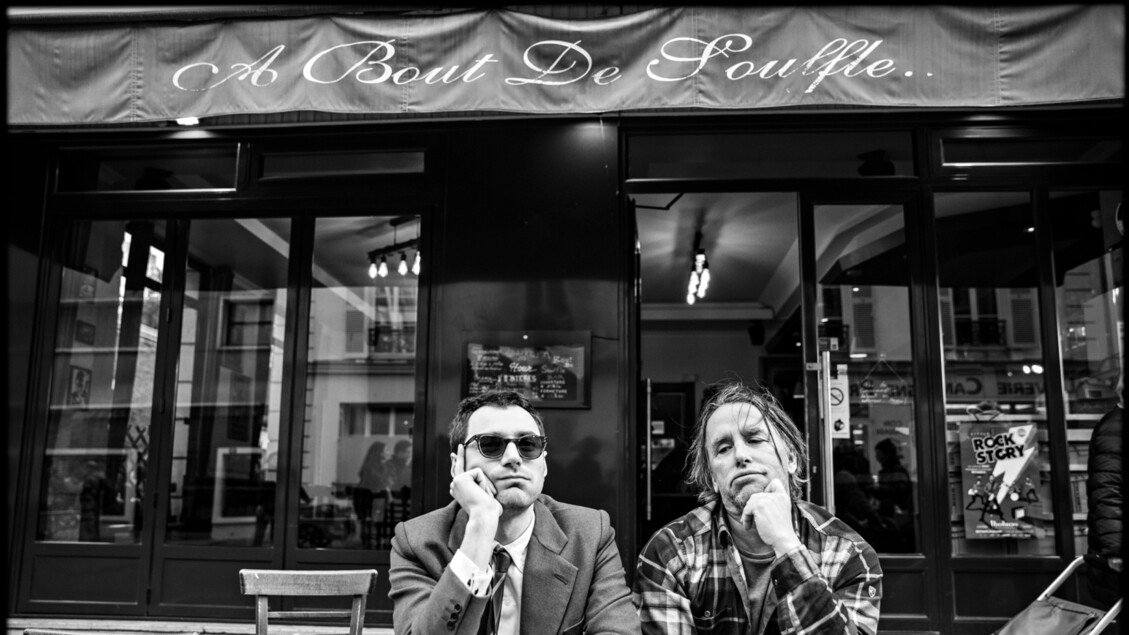
(by Francesca Pierleoni) There is always “a revolution in cinema somewhere in the world, there is always someone doing something different. Art and artists must rebel against the status quo. This is a moment in history in which you particularly feel this need. In the modern world there are so many pressures towards conformity and commercial pressures, that there is always a lot to rebel against”. Word of Richard Linklater, one of the most original voices of cinema outside the Hollywood mold for almost 35 years, who arrived at the Rome Film Festival to receive the Lifetime Achievement Award, be the protagonist of a meeting with the public, and present Nouvelle Vague, a journey into the making of the directorial debut of one of the symbols of the Nouvelle Vague Jean-Luc Godard, Breathless.
The film which stars Guillaume Marbeck, Zoey Deutch, Aubry Dullin, Adrien Rouyard, Antoine Besson, Jodie Ruth, debuted at Cannes and will be in theaters with Lucky Red and Bim in early 2026. Linklater traces a behind-the-scenes look in black and white between life and cinema, telling how that masterpiece was born, between doubts, difficulties, clear choices and genius. A journey into the earthquake in the seventh art that was bringing the French new wave in those years. “There was a great ferment in cinema in many parts of the world in those years, even in the United States, but Paris was certainly the hub.
There was such a concentration of directors and films… they then had the Cahiers du Cinema as a basis. It seemed like the best atmosphere to express their love for cinema, moreover in this sense they were excellent sellers of themselves. Godard then “is so different: there is a revolution going on in the air, but above all in this man. You can see it in the way he creates his cinematic language”. On the authors “of my generation and those following mine, it has always had such a vast influence that it has become part of the language of independent cinema and the most personal cinema. For me, it is always about freedom of expression. Feeling that you can make a film about anything, any topic, even the most intimate, without limits”.
Linklater, born in 1960, explored cinematographic genres and forms. from the story of friendship and love in the Before trilogy with Ethan Hawke and Julie Delpy, (Before Sunrise, Before Sunset and Before Midnight) to the dystopian A Scanner Darkly, without ever having been afraid to experiment with multiple levels of reality, as in Waking Life or of time, as in Boyhood, created by shooting the story over 12 years. A form of storytelling that he is also pursuing in making the adaptation of Stephen Sondheim’s musical Merrily We Roll Along, which began filming in 2019. “I don’t think things have changed much in the last 65 years for independent cinema. There is no money, the same battles are fought. What has changed a lot is distribution. Given the progress of technology, perhaps this is the best time for a director starting out but we also experience the greatest challenge to show your film, to get what you create to the public.”
In addition to Nouvelle vague, Linklater also has Blue Moon coming out (it debuted at the Berlinale), about the composer and lyricist Lorenz Hart (Ethan Hawke). “There I tell the final part of an artist’s life, here the beginning, which is generally funnier, more optimistic” he comments, smiling. Guiding him in the choices of projects to make “I never think in terms of career, of path. Generally there is a story that obsesses me and so I simply try to make that film, and it often takes a long time to get financing and support. I have always struggled in these 35 years to finally make the next film. There is no general plan”.
Reproduction reserved © Copyright ANSA
André Itamara Vila Neto é um blogueiro apaixonado por guias de viagem e criador do Road Trips for the Rockstars . Apaixonado por explorar tesouros escondidos e rotas cênicas ao redor do mundo, André compartilha guias de viagem detalhados, dicas e experiências reais para inspirar outros aventureiros a pegar a estrada com confiança. Seja planejando a viagem perfeita ou descobrindo tesouros locais, a missão de André é tornar cada jornada inesquecível.
📧 E-mail: andreitamaravilaneto@gmail.com 🌍 Site: roadtripsfortherockstars.com 📱 Contato WhatsApp: +55 44 99822-5750