
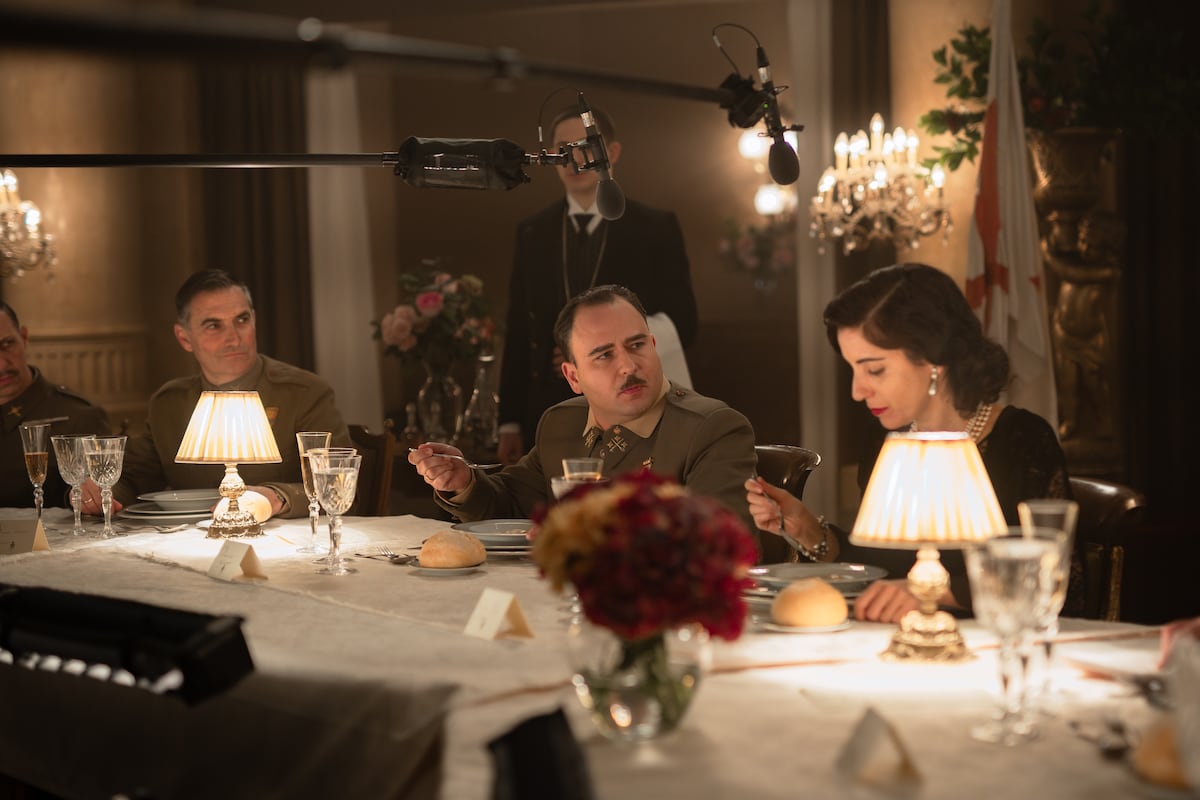
Since the death of the dictator Francisco Franco until today, more years have passed—in a month it will be half a century—than those in which the military coup leader ruled. And yet, Spanish cinema and series have dealt little, very little, with the figure of Franco, and even fewer have comedies been made about him. The premiere this coming Friday of The dinner, by Manuel Gómez Pereira, based in turn on a comic work by José Luis Alonso de Santos, which its author was unable to release for a decade, highlights how the last taboo of Spanish audiovisual comedy is called Francisco Franco Bahamonde.
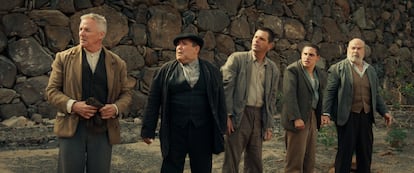
Dinner It takes place on April 15, 1939, two weeks after the end of the Civil War, when suddenly a banquet for Franco and his generals is organized in the Palace Hotel in Madrid in a matter of hours. Impossible, says the director of the luxury accommodation (Alberto San Juan), now the Palace is a hospital. Well, the lobby will have to be cleared to celebrate the banquet there, orders a psychopathic Falangist (Asier Etxeandia). There are no chefs, they are in jail. For this reason, the military mayor (Mario Casas) who organizes the banquet saves in the extremes to the kitchen team, all red, from being shot. Now, those cooks, would they prefer to assassinate the Caudillo or flee? Will it be a damn bastards cañí?
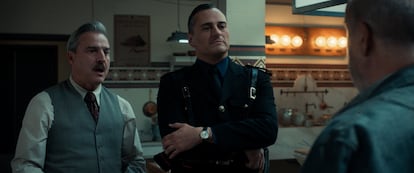
Gómez Pereira says that he has had this project in his hands since 2008. “Alonso de Santos wrote it in 1998 and did not manage to release it until 2008, when Miguel Narros directed it. It starred Sancho Gracia, who was also a producer with a sense of smell, and he passed it on to me. So I have had this idea in my backpack since that year,” he says. “It was not an easy film to make, because in Spain as soon as you want to talk about the Civil War everything gets complicated. A television network closed its doors on us and it stayed there.”
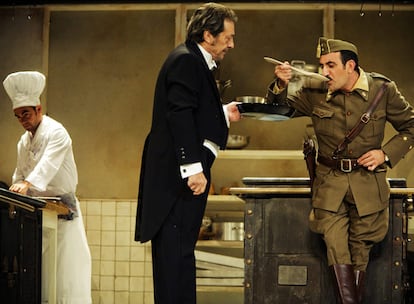
The person who opened the season was Luis García Berlanga with The heifer (1985) and there has even been a crossover between Civil War and zombies in Malnazidos (2020), but Franco never appeared in the equation. In the summer, Carlos Areces, who has played the dictator up to five times in film and television, said in an interview on Cadena Ser: “Before it was not possible to play this character. Now… not now either,” and recalled that even making humor about issues related to the dictatorship is still a delicate area: “A Twitter girl went to trial for making a joke about Carrero Blanco, so…”.
“It’s not easy, no,” confirms Gómez Pereira. “And I’m not even talking to you about a satire on Franco, like those that have been done with other dictators like Hitler,” who even appeared caricatured in the middle of the Second World War in two masterpieces: To be or not to be, de Ernst Lubitsch, y The great dictator, by Charles Chaplin. “More than the mockery, I was interested in the dramaturgy of the work and its sense of humor, with which I connect.” The filmmaker, who co-wrote the adaptation with Yolanda García Serrano and Joaquín Oristrell, wanted to delve into “what was happening to those people in an absolutely polarized Spain, with a hotel that represented the entire country, with inhabitants who did not stop suffering.”
However, in the original work Franco was only mentioned; Here he appears, in the last third of the film, played by Xavier Francés, although he is not the protagonist, a game that the filmmaker already used, in that case with King Juan Carlos, in Love seriously harms health (1996).
Furthermore, with the Royal Family there are no longer any contentions. The days are long gone, 2007, when a judge kidnaps the magazine Thursday for its cover in which the then princes of Asturias were caricatured in a sexual position. “We are not very ambitious,” argues Gómez Pereira. “In other countries they don’t have that fear. We are in a very modest moment, where the politically correct triumphs, where everything scares us. I think we have to move on from that. I even feel that we shot films in the nineties that wouldn’t let us today.”
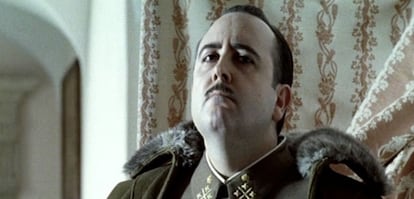
The one who did jump into the void was Albert Boadella, who released the film in 2003 Have a good trip, Excellency! with Ramon Fontserè playing Franco in his last two months of life. “Humor about Franco is our pending subject,” Boadella acknowledges. “I used sarcasm, although in his last weeks, those of agony, the absurdity of that reality far surpassed our fiction. As a man of theater, I felt that I had to do something about a guy who was so present in my younger years (the playwright was born in 1943). He was a very unpleasant character for me. Deep down, in the world of comedians, there is an element of therapy when talking about topics that They have disturbed us, like this one. You make a drama about them to settle things.” As the comedian Darío Adanti, the actress Ana Ramos and the artist Eugenio Merino do every day on the 20th of each month with the theatrical show Jokes against Francowhich can be seen next Monday at the Teatro del Barrio in Madrid. The trio considers these jokes a “document of anti-fascist resistance.” They are about Franco, but, obviously, without him.
For Boadella, Spanish cinema needs to “look more inward.” “There are only a handful of films about Franco and none as cruel as mine, and that is not normal. We are overlooking a formidable issue,” he continues. How did Fontserè approach the role of the dictator? “When he performs them, Ramon possesses the characters, he does not imitate them. He enters them and finds their inner rhythmic melody. And then the gestures come out.”
At one point, Dinner the plot of the story is rosy Damn bastards. The director points out: “It is the film that I like the most by Tarantino, because it is probably his most European work. Although the one in which he plays most at rewriting history is Once upon a time in…Hollywood. We also think about Jojo Rabbit. In reality, you can count dictators from many points of view.”
Are there still many fears and some censorship on some topics in 2025 in Spain? Boadella remembers that the theater subsists in most cases through public subsidies. “And that’s where the Administrations decide. There is a coercion in not being able to get along with the councilor, the counselor or the minister.” Gómez Pereira analyzes the audiovisual: “Sometimes they blame us for a lack of vision. And that does not come from the filmmakers. If you realize, the things that are done lately on television are very similar, the risk is disappearing and that is terrible. From the offices of the executives there is too much judgment about whether a film can be made or not, and society is not taken into account. You end up passing through such filters, that in the end that project that you have in your head It falls apart because of the cast, because of sequences that suddenly tell you they can’t happen, because of the financing… You have to fight a little more.”

André Itamara Vila Neto é um blogueiro apaixonado por guias de viagem e criador do Road Trips for the Rockstars . Apaixonado por explorar tesouros escondidos e rotas cênicas ao redor do mundo, André compartilha guias de viagem detalhados, dicas e experiências reais para inspirar outros aventureiros a pegar a estrada com confiança. Seja planejando a viagem perfeita ou descobrindo tesouros locais, a missão de André é tornar cada jornada inesquecível.
📧 E-mail: andreitamaravilaneto@gmail.com 🌍 Site: roadtripsfortherockstars.com 📱 Contato WhatsApp: +55 44 99822-5750