
Anyone familiar with Guillermo del Toro’s films, such as the Oscar-winning “The Shape of Water,” should be able to imagine what his new movie, “Frankenstein” is like. It’s grand, overstuffed, overlong and often disgusting to look at – and yet at the same time often brilliant and sometimes beautiful and moving.
It’s a movie that impresses by seeming as if the filmmaker put everything he had into it, even as he makes us think he probably should have kept a good deal out of it.
Like every “Frankenstein” movie, it’s based on Mary Shelley’s 1818 novel. But unlike almost every other “Frankenstein,” it really finds its inspiration in the novel and not in the dozens of screen adaptations going back to 1931.

Mia Goth in a scene from “Frankenstein.” (Netflix)
This is not to say that del Toro’s film is faithful to its source, but rather that it’s a direct engagement with its source – not a copy, but an intelligent, impassioned response.
Even so, that intelligence and passion, combined with the visual frame of reference spanning from Caravaggio to Thomas Eakins, don’t necessarily ignite interest in an audience. For much of “Frankenstein,” the experience is that of watching a familiar story play out almost in slow motion, albeit with some interesting variations. At two and a half hours, it’s a long film that feels even longer. What makes it more frustrating, though, is the realization it easily could have been a rewarding and effective 100-minute movie.

Oscar Isaac stars as Victor Frankenstein in Guillermo del Toro’s “Frankenstein.” (Ken Woroner/Netflix)
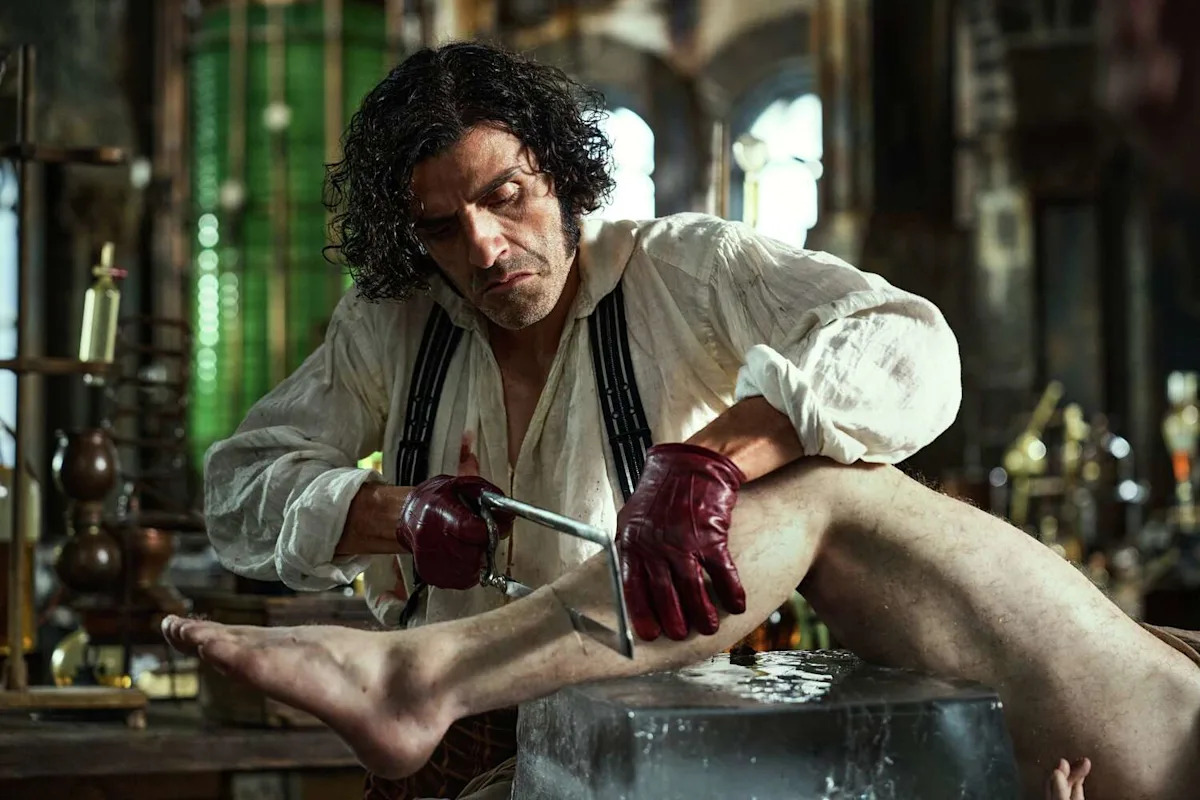
Oscar Isaac, not ideally cast as a Joaquin Phoenix-type weirdo, plays Victor Frankenstein, an egomaniacal genius who scandalizes the scientific world with grotesque demonstrations. He proves he can, at least briefly, bring dead creatures back to tortured, painful life. Based on these repulsive-looking experiments, he has the idea that he can conquer death. To that end, he finds a wealthy investor named Harlander (Christoph Waltz), whose surface gentility masks a raging inner life.
The first half of “Frankenstein” is an endurance test, punctuated here and there by some genuinely winning scenes. Mia Goth (“MaXXXine”) plays the fiancée of Victor’s brother, and over the course of dinner, shows herself to be Victor’s intellectual equal and his moral superior. Theirs is a case, not of opposites attracting, but of similar sensibilities finding each other both arresting and repellent.
Gradually, with all too much leisure, the movie hits all the various Frankensteinian plot points. Then, just as it seems as though it finally might be winding down, something unexpected happens: The narrative backs up and starts telling the same story, but this time from the standpoint of the monster.

Christophe Waltz in a scene from “Frankenstein.” (Ken Woroner/Netflix)
When a movie that’s not working blithely decides to start itself over, that’s rarely good news. “Frankenstein” is the exception.
More Information

2 stars
“Frankenstein”: Gothic drama. Starring Jacob Elordi, Oscar Isaac, Mia Goth and Christoph Waltz. Directed by Guillermo del Toro. (R. 149 minutes.) In theaters Friday, Oct. 17.
Here, the movie reanimates. What’s dead comes alive. Suddenly, we’re watching the film that del Toro should have made, not the story of a cruel, bloviating scientist who thinks nothing of keeping a butterfly in a tiny jar and watching it suffer.
At this point, we get the saga of a sensitive soul (Jacob Elordi) brought into the world against his will and given a body and face guaranteed to frighten everyone he encounters. In a sense, del Toro does make this other, better movie – unfortunately, he burdens it with his own hubristic ambition to create the ultimate, most comprehensive and definitive “Frankenstein” of all time.
Still, there’s no denying the beauty and artistry of the movie’s last hour.

Oscar Isaac in a scene from “Frankenstein.” (Netflix)
As the monster, Elordi narrates with delicacy and emotion the story of how he acquired language and then knowledge.
Along the way, del Toro does something one would think to be impossible – he reclaims the famous blind man sequence from the realm of the comedic, specifically from Mel Brooks’ “Young Frankenstein.”
All that said, “Frankenstein” is not a so-so film. It’s a mix of weak and strong that might average out in the so-so category, but there’s not a minute of it that’s mediocre.
Some people will decide that it’s not worth suffering through the bad parts to get to the good, and others will disagree.
What I’d say is this: If you decide to see this movie, and you’re having trouble finding parking, don’t sweat it. If you miss the first hour of “Frankenstein,” you’ll be better off.
Mick LaSalle is the film critic emeritus of the Chronicle. Email: askmicklasalle@gmail.com
This article originally published at Guillermo del Toro’s ‘Frankenstein’ stitches genius and excess into one grotesque creation.

André Itamara Vila Neto é um blogueiro apaixonado por guias de viagem e criador do Road Trips for the Rockstars . Apaixonado por explorar tesouros escondidos e rotas cênicas ao redor do mundo, André compartilha guias de viagem detalhados, dicas e experiências reais para inspirar outros aventureiros a pegar a estrada com confiança. Seja planejando a viagem perfeita ou descobrindo tesouros locais, a missão de André é tornar cada jornada inesquecível.
📧 E-mail: andreitamaravilaneto@gmail.com 🌍 Site: roadtripsfortherockstars.com 📱 Contato WhatsApp: +55 44 99822-5750