
Canal Brasil premieres the miniseries on October 31st Spring in the Teeth – The History of Secos & Molhados. Based on the journalist’s book of the same name Miguel de Almeida – who wrote the script and directed the special –, it tells the birth, rise and dissolution of one of the biggest phenomena in national showbiz.
For those who have spent the last 50 years on Mars, here is an explanation from someone who, at the age of six, had a poster of these guys in his living room. Formed by John Ricardo, Gerson Conrad e Ney Matogrossoo Dry & Wet it was a very complex combination of rock and folk, in which many lyrics were taken from poetry – ranging from Vinícius de Moraes and Manuel Bandeira to Solano Trindade and João Apolinário, João Ricardo’s father.

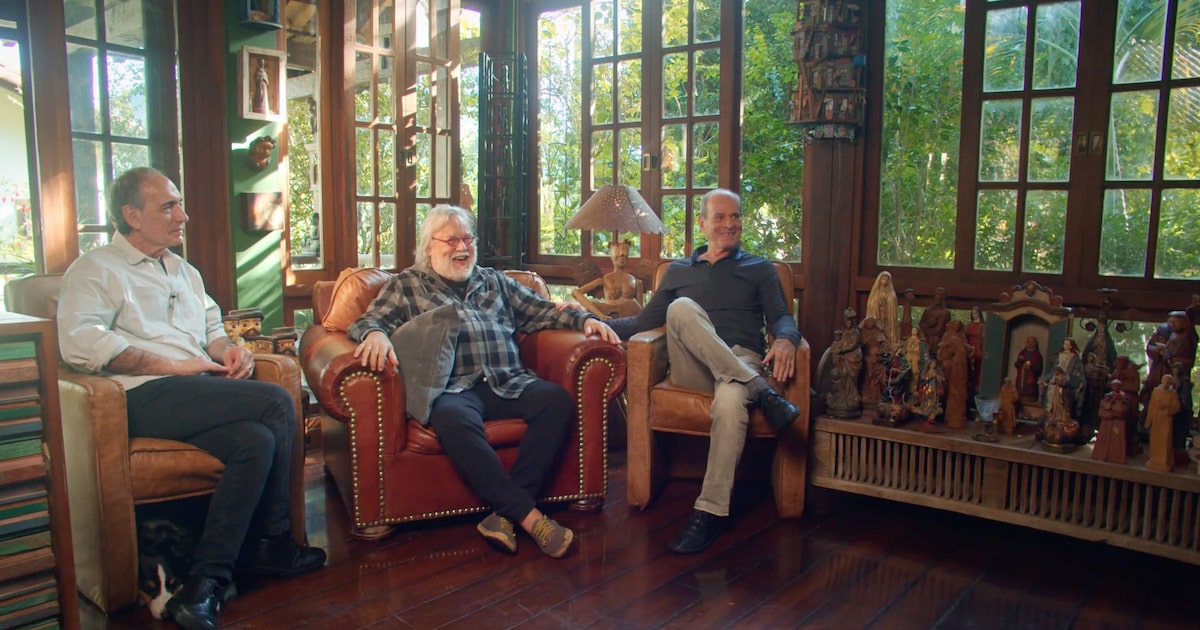
Gerson Conrad, Paulo Mendonça and Ney Matogrosso in ‘Primavera nos Dentes – A História do Secos & Molhados’. Photo: Santa Rita Films/Disclosure
The special touch was given by Ney’s dancing and countertenor voice, and the makeup that reminded him of glam rock. Between 1971 and 1974, the group released two albums, recording songs such as The Vira, Latin blood, He speaks, Astral Flowers e Rosa de Hiroshimaamong others, and dissolved due to financial management problems.
Spring in the Teethhowever, suffers from an evil that plagues most documentaries: the refusal of one of its characters to embark on the project. And what a character… João Ricardo was the group’s mentor, its main composer and owner of the brand. He did not give an interview and did not release his creations to be played in the episode (as a consolation, all that remains is to watch the Dry & Weta 2021 documentary directed by Otávio Juliano, in which Ricardo gives his version of the group’s history).
Legally, the singer and author is correct. I even turned to two copyright experts to see if there would be conditions to bypass this veto. Mariana Mello, legal consultant at the Brazilian Association of Music and Arts (Abramus), and Deborah Sztajnberg, effective member of the copyright committee at the Institute of Brazilian Lawyers (IAB), are unanimous in explaining that the author’s rights are protected by law and that they can veto the use of their work if they do not agree with its content. But how far will our musical history be hampered by a truckload of heartbreaks?
Ney Matogrosso in ‘Primavera nos Dentes – A História do Secos & Molhados’. Photo: Santa Rita Films/Disclosure
One of the biggest clichés about our country is that we have no memory. In the case of musical documentaries, for example, this is an aspect that is still taking small steps (we praise, however, the performance of the In-Edita festival of musical productions from around the world that has opened space for Brazilian creation).
We often come across stories that are half-told because one or more people involved did not want to collaborate with the project. It is the case that Grave Endurance (2017), directed by the same Otávio Juliano from João Ricardo’s film. Max and Iggor Cavalera, respectively the guitarist, vocalist and drummer of the group from Minas Gerais (as well as, of course, founders) refused to give statements and release their songs.
What we have is a game of push and shove. The Cavaleras claim that they did not have access to the filmed material. The other remnants of the classic formation (Andreas Kisser, guitarist, and Paulo Jr., bassist), in addition to Juliano himself, maintain that, in fact, there was a delay for the two dissidents in watching what had been done and then wanting to re-edit the film in their own way.
The mess continues. Stories about Clube da Esquina come out without the participation of Milton Nascimento – an absence that was not even explained. Rita Lee: Mania de Vocêa beautiful documentary about the first lady of Brazilian rock, omits her participation in Mutantes simply because there was no interest from guitarist Sérgio Dias (who was part of the group alongside his brother, Arnaldo Baptista, and Rita herself) in releasing images of the group and their compositions.
The case of Renato Russo is even more painful. In 2021, Giuliano Manfredini, son of the leader of Legião Urbana, vetoed a documentary about his father that would be broadcast by Globoplay. And he has nothing less than one of the last records by Elza Soares, who died in 2022: a searing version of What country is thisemblematic rock of the Brasiliense group.
The veto on documentaries is not exactly a joke: there are examples of international productions stopped because of problems with the documents and their heirs. Netflix shelved the story of singer, songwriter and multi-instrumentalist Prince and producer Pharrell Williams shelved a biographical special that would be directed by Frenchman Michel Gondry – by Eternal Sunshine of the Spotless Mind. The solution, in this case, was to create another special, directed by Morgan Neville (who won an Oscar for Best Documentary for 20 Feet from Stardom2014), in which Williams’ story is told through Lego figures.
Spring in the Teethin turn, does not feature Lego figures. But it gives voice to co-protagonists in the success story of Secos & Molhados. Case of Willy Verdaguer (the author of the sinuous bass line of Latin bloodwhich sticks to the listener’s cerebellum) and the pianist Emilio Carrerawho were part of the band that supported João, Gerson and Ney.
Emílio Carrera in ‘Primavera nos Dentes – A História do Secos & Molhados’. Photo: Santa Rita Films/Disclosure
In the absence of original songs, Verdaguer and Carrera created themes inspired by the trio’s repertoire, which may even appear as new songs for the group. Spring in the Teeth It’s a well-told story that helps to understand the reason for the group’s success (but it’s well worth reading Miguel de Almeida’s book, which contains testimonies from the complainant).
There are, however, some considerations. Often, Ney’s revelations come more from the liver than from the brain – when he highlights the rude way in which João Ricardo treated people. The second formation of Secos & Molhados, from 1978, in which Lili Rodrigues tried to emulate Ney’s voice, also received a dose of muxoxos and disdainful speeches, although it resulted in a great album (in addition to João Ricardo’s first solo, from 1975, which featured Roberto de Carvalho on guitar). And we need to stop once and for all with this urban legend that the American rock quartet Kiss “stole” the concept of singing in makeup from Secos & Molhados. Do you see how you were missed in this documentary, João Ricardo?

André Itamara Vila Neto é um blogueiro apaixonado por guias de viagem e criador do Road Trips for the Rockstars . Apaixonado por explorar tesouros escondidos e rotas cênicas ao redor do mundo, André compartilha guias de viagem detalhados, dicas e experiências reais para inspirar outros aventureiros a pegar a estrada com confiança. Seja planejando a viagem perfeita ou descobrindo tesouros locais, a missão de André é tornar cada jornada inesquecível.
📧 E-mail: andreitamaravilaneto@gmail.com 🌍 Site: roadtripsfortherockstars.com 📱 Contato WhatsApp: +55 44 99822-5750